American Sniper (2014)

Written for RAF News Jan 2015

American Sniper opens to an Iraqi mother and son approaching a group of American Navy SEALs. Something is off about her gait… her arms aren’t moving. She is holding something beneath her clothing – an RKG Russian grenade – which she hands to her child before sending him running toward the platoon. All of this is witnessed through the scope of Chris Kyle’s rifle whilst his finger rests on the trigger.AMERICAN-SNIPER

This gripping open to Clint Eastwood’s latest contains the essence of the film: the intense focus and moral deliberation (or lack thereof) of decorated SEAL Chris Kyle (Bradley Cooper) caught in extreme close-ups, fast-paced editing and confining sound design.

An adaptation of Kyle’s best-selling autobiography, the film carries his values and moral certainty in tone, but also in Cooper’s performance – suitably beefed up and puffed out with a deep Texan drawl. Accumulating 160 confirmed kills (255 unconfirmed) over four tours of Iraq earned him the title of ‘Legend’ among friends and ‘The Devil of Ramadi’ among Iraqi insurgents. Burly, brave but never boastful, Kyle’s dedication to God and his country is unwavering, though it is certainly tested by the many faces of evil that threaten his brothers-in-arms.

The binary division of heroism and pure evil can make the film appear cartoonish at times – more a western than a war film – with Kyle’s patriotism becoming the most aggressive thing about him. Shown to be a gentle and compassionate man, we are shown the struggle he has in returning back to ordinary life with his wife (Sienna Miller) and kids. Intending to give a more rounded view of the most lethal sniper in the US military, these familiar scenes feel tired and almost obligatory.

It is in the combat scenes that Eastwood flourishes, unsurprisingly. At one point, dizzying direction places you at the heart of a shootout when all figures in the frame are swallowed by a sandstorm. These moments of raw cinematic action deliver concentrated doses of suspense that make the film worth seeing.

Edge of Tomorrow (2014)

Spoilers ahoy.

Edge of Tomorrow is a futuristic action/science-fiction film that takes place during a war with an invading alien race who seem to have some control over time. A high-concept film that cleverly works in a conceit that excuses the film for being very Hollywood.edge-of-tomorrow

Tom Cruise begins as William Cage: an inexperienced, queasy-at-the-sight-of-blood, coward officer. This obviously must change – he is Tom Cruise. Confessing to be more involved in the campaigning side of things and attempting to blackmail his way out of participation, Cage finds himself volunteered to fight on the frontline against these alien invaders.

Very soon he will find himself dropped into combat wearing a future-tech soldier-suit, the type to have plasma guns appear from hidden crevices, unfortunately he hasn’t been trained on how to use it. Instead the action hero in the film takes the shape of Emily Blunt as Rita: ‘the full metal bitch’ as they are sure to remind us. Picking up from her previous sci-fi action film Looper, Blunt holds her own against another 50-year-old action star with the same stony faced stoicism. She dances around the battlefield whilst dear old Cage only manages to pick off one of the so-called Mimics before dying.

And then the day starts again… turns out the creature the Cage killed has locked him into his own private Groundhog Day. Now he must use this infinite repetition to his advantage and use his superseding knowledge of the day to find help and get trained up. He must escape the strict watch of his General for instance, and so whilst on exercise he tries to roll under a moving car in order to break away. Every time he mistimes the move and is chewed up by the tires of the oncoming vehicle, his day is reset. Once this is established with the audience, the film doesn’t need to explain how many times Cage has attempted an act of daring, we can safely assume he has tried it over and again until it has worked – we are merely catching his successful attempt.

In Mission Impossible we have no such excuse for the luck that is granted Ethan Hunt. Action films often preface their death-defying stunts by endowing the hero with a history in the special forces, with a very specific set of skills as it were, but it cannot excuse these moments of sheer luck that are threaded throughout Hollywood films – those purely cinematic moments that defy realism. Edge can do precisely that, thereby explaining away why Cruise can roll under a moving car. A beautiful flourish.

We later find out that Blunt too had this power but lost it.. that’s why she is such a bad-ass. She decides to train Cage so that they can work as a team to find the headhoncho alien and win the war. The reset device is used to create a unique kind of montage in which comedy is derived from the execution of the protagonist: if he slips up, she shoots him. LIVE. DIE. REPEAT (get it?) With fast-paced editing and reused shots, this technique provides well-earned comedic relief. If not simply relieving from the cold, austere seriousness of Blunt. She is training him. An unlikely turn for a Cruise action film – though this is corrected when he overtakes her and reprises his role as action hero, saving her in return (call it even) then saving the day like she never could (not quite even) then she is demoted to a fleeting love interest.

Garth
Rick: He saved my life once. I saved his twice, so I was one up

Problem is that the stakes have been wiped as there is no longer the threat of death. And so comes a flimsy explanation for how this power is lost, turning the film into ordinary Hollywood fair, especially when in the final moments of the film it seems to employ its own rules and revive the hero for a happy ending.

Edge of Tomorrow utilises it’s concept to justify the Hollywoodness that it shines with, and though it can’t sustain this subversion until the very end, it’s impressive while it lasts.

Let’s Be Cops (2014)

Written for RAF News September 2014

A buddy cop bromance with two guys pretending to be cops but careful to clarify that they are manly and heterosexual at that.

LET'S BE COPS

Ryan (Jake Johnson) and Justin (Damon Wayans Jr.) are bickering thirty-year old friends, afraid of going nowhere until they find themselves in police costumes at what turns out to be a masquerade party. Turned out onto the streets they stumble upon the power that apparently comes with a uniform and enough self-belief. Ordering people to do as their told and with hordes of loose women throwing themselves at them, the allure of being policemen is hard to give up. Evidently: with great power comes no responsibility.

Ryan seems to find his purpose in life and so commits to the role buying a cop car and all the appropriate accessories from eBay. Adopting the role fully and dragging along his friend in order for him to man up and be more assertive, the two end up in easily avoidable trouble with some frighteningly typical Russian villains.

A lot of the story and the characters are cartoonish, a point which is restated with constant physical comedy. The cocksureness of Ryan is the catalyst for all the action in the film whilst Justin is relied on for comic relief: playing flamboyant for laughs with funny voices and effeminate tendencies until he is told to man up; or rather be less of a bitch. The homophobia underlying this central message makes the misogyny seem like an affectation of the film, and not simply the characters – which is worrying.

The film doesn’t ask to be taken seriously. That much is clear from the trailer or the title even. So if you can divorce yourself from seriousness and maybe a sense of morality, there are some laughs to be had. And a lot of two guys slapping each other.

Nymphomaniac Vol. 1 & 2 (2014)

Some thoughts on the structure of Nymphomaniac – sidestepping comments on some truly bizarre performances including Shia LaBeouf, whose accent genuinely provoked laughs from the audience I sat amongst.

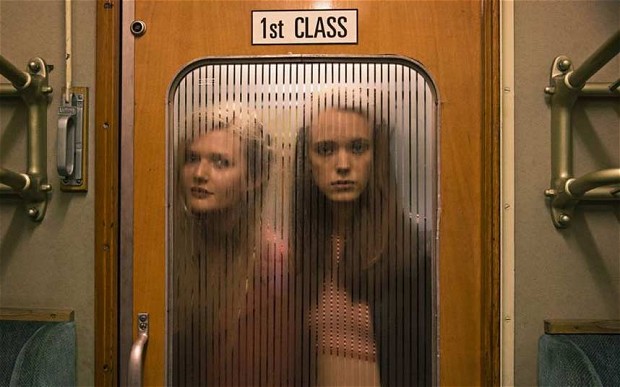
With his tongue still firmly in cheek, Lars von Trier continues to try and shock audiences as he explores female sexuality in the early stages of a young nymphomaniac’s life – humorous for the first volume at least until it starts to run dry. Drifting from the more serious, though it certainly retains a level of dramatic darkness, von Trier plays with the audience as he his known to do and tries for shock so blatantly at points that it begins to feel like a parody of his own style.

nymph

The crowd I sit with in this odd Friday matinee, while the sun shines bright outside, is made up of mostly guys on their own. A few couples and the odd scattering of fems but predominantly men on their own. I am one of them. Still this is strange – I feel strange. Whether through discomfort from the subject matter, or from the lack of give in the material of our collective crotches, there is a lot of shuffling between laughs. Alan Moore, author of graphic novel The Lost Girls which would perhaps fall under the self-same categorisation, has commented on the idea of ‘intellectual pornography’: that it is a difficult feat that has to fight for the blood to rush to either of the brains; that you will ultimately be stimulated on one level only. Men anyway. Us lone men fidgeting in the dark. So maybe von Trier has an alibi for the film not satisfying audiences intellectually…

What I found intriguing about Nymphomaniac was its place in the context of von Trier’s films as subverting the form of storytelling and preventing escapism.

Continue reading “Nymphomaniac Vol. 1 & 2 (2014)”

Blue Ruin (2014)

Written for RAF News April 2014

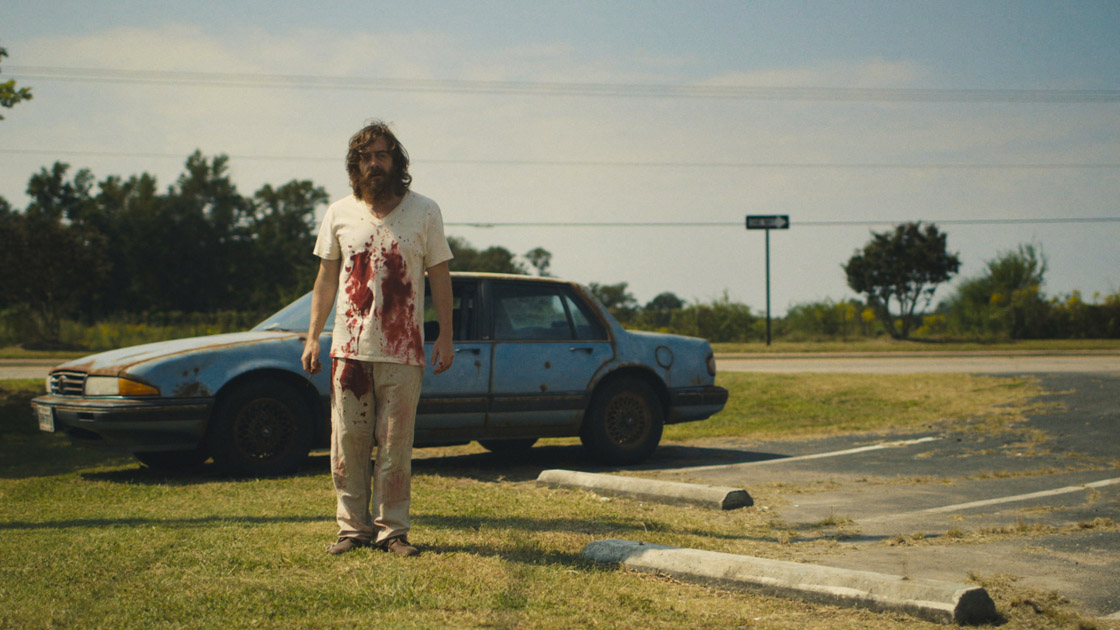
Dwight (Macon Blair) is a simple man of few words, who sets out to even the score when he discovers that the man charged with the murder of his parents is soon to be released from prison. Returning to his rural Virginia hometown in his run-down car, Dwight hunts down the freed murderer to exact his revenge. There is little time to process the events however as he immediately becomes the subject of another retaliatory hunt, and thus the inevitable cycle of revenge prevents escape for anyone involved.Blue Ruin

Unlike Drive (2011), which had a sleek and purposefully silent Ryan Gosling as its anti-hero, Dwight just doesn’t really have anything to say. Where Gosling was a professional stunt-driver, Dwight is in fact homeless and lives in his car – the titular blue ruin which is seen rusted and riddled with bullet holes. He has nothing else and as such has nothing to lose. As a result, Dwight’s vacuous nature is given a volatile edge that keeps you in prolonged suspense.

Sudden moments of violence take you by surprise in their spontaneity as well as their graphic detail. They create a sense of unpredictability that keeps you in the moment and immersed in the tension, whilst dwelling on the results of violence that are usually glossed over in cinema. This is a film that revels in the complications and failures that stem from revenge.

Dedicated purely to his pursuit, Dwight can make you feel locked out and lacking any real connection with him. However, perhaps for this very reason, it feels genuine – believable almost. Almost. Comedic relief comes eventually in the form of Ben (Devin Ratray) an old school friend who decides to help Dwight without asking too many questions – not that he would get much from him anyhow.

Blue Ruin’s masterful element is in its moments of comedy that punctuate the bleakness. A sigh of relief before you return to the dark reality of the film. Though it is tough to connect with Dwight, the naturalism of the story and its cleverly reserved delivery keep you captivated.

Blog at WordPress.com.

Up ↑