Storm Boy (2019)

Storm Boy': Review | Reviews | Screen

Written for RAF News April 2020

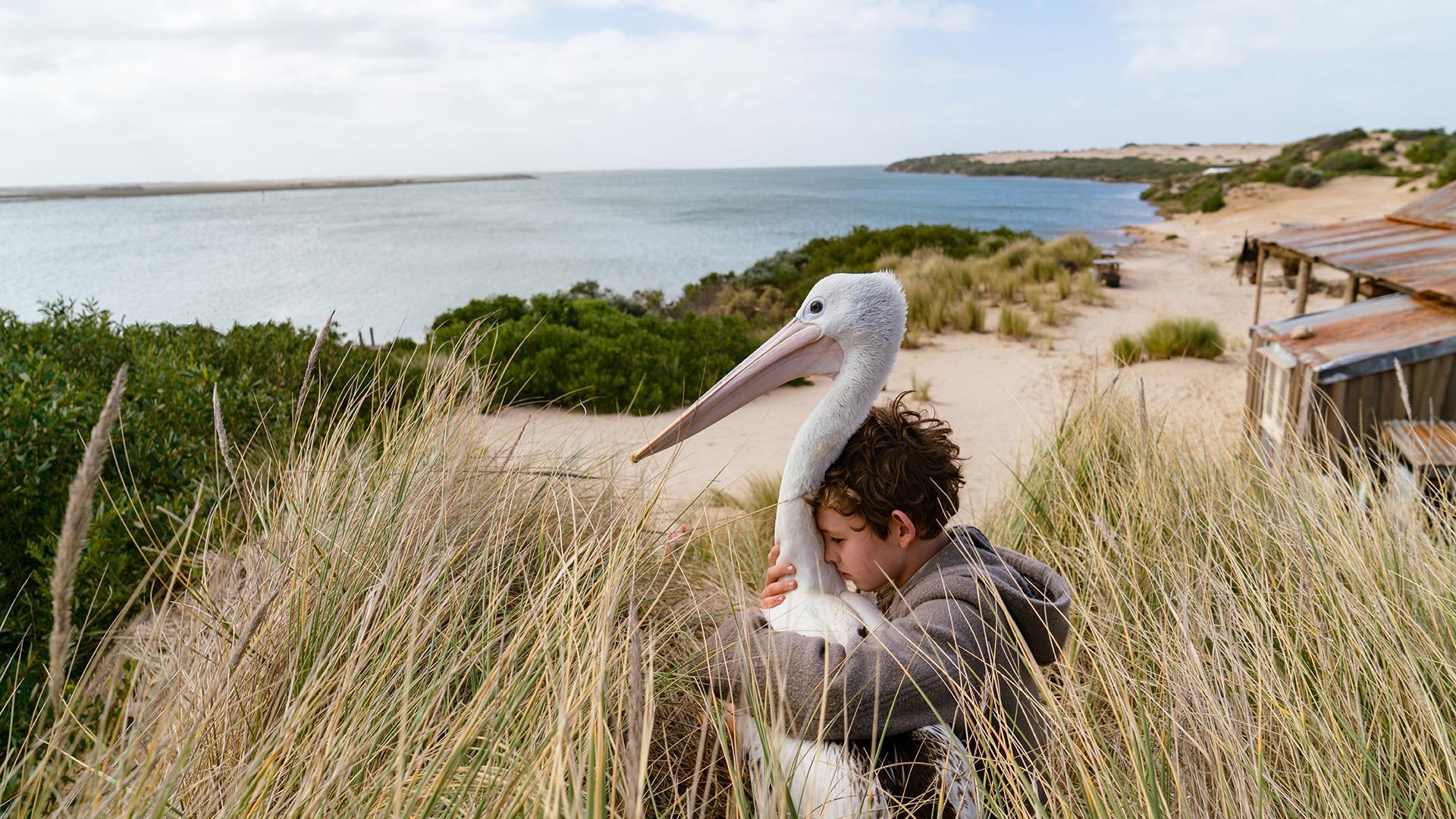
Geoffrey Rush plays Michael Kingley, an ageing businessman who is about to vote on whether a mining company can exploit the land that he grew up on, the beautiful South Australian beaches of Coorong. This casts him back into memories of his childhood and in particular his relationship with Mr. Percival, a pelican.

Mostly told through flashbacks, Mike is played by Finn Little as a young boy, living out in a shack with his stoic but sweet father (Jai Courtney), reading Lord of the Flies together, apparently serving as a corporate manifesto in this context.

However it is when he meets a local Indigenous man by the name of Fingerbone Bill (Trevor Jamieson) that he starts to connect more with nature. The birds native to the island are being hunted for sport and whilst his own father is indifferent, he feels an urge to protect them. Discovering an orphaned nest of chicks with Bill, he takes them home to raise them himself.

Whilst his father is initially resistant, he sees the passion that has awoken his boy and so supports in designing contraptions to feed them until they can do it for themselves. Not quite the emotional turmoil of Casper and his Kes, young Michael still finds an escape in the rearing of the birds, opting to keep one as the family pet.

As they grow larger we some footage of these remarkably playful pelicans, creating a real connection between Michael and the birds. It is the unsubtle dialogue that treads on the tenderness of the story. The framing device with Rush doesn’t really add anything to the story, other than a heavy-handed morality.

Apparently a well known Australian novel that had been adapted into a beloved-to-some movie, this recent adaptation doesn’t do anything very interesting but the innocence of children and animals is a surefire way to get a dose of empathy.

The Rest of Us (2020)

The Rest of Us (2020) - Rotten Tomatoes

Written for RAF News April 2020

Cami (Heather Graham) and her teenage daughter Aster (Sophie Nélisse) live in a beautiful hill-top home isolated from the world, that is until some guests arrive in the shape of her ex-husband’s new wife and young daughter following his sudden accidental death.

When Cami finds out that Rachel (Jodi Balfour), the so-called ‘homewrecker’, has not only been widowed, but unravelling financial struggles have lead to her being evicted, she offers her slice of paradise as a place to stay. What was perhaps a sympathetic gesture, is initially refused but soon becomes the only option, much to the annoyance of everyone involved.

The Rest of Us looks at the relationships between these women, how they deal with grief over this absent male presence, and the ripples of his decisions that continue to affect them. Both mothers fail to connect with their own daughters, Cami professing to have a way with kids, where Rachel is closer in age with a rebellious mindset to get approval of the teenager. Together forming a yin-yang of roles, this of course does not account for jealousy, rivalry and social tensions – with some secrets threatening to divide the family up once more.

There is a maturity to the storytelling which is able to avoid over-explaining. A quick cutting style punctuates some funny moments and dramatic turns at the end of a scene, but it’s continued use makes it feel choppy. It has all the makings of an indie film but the editing style of an action movie. The fast pace moves the story along but also stops it from finding a rhythm or slowing down enough to connect with characters emotionally. Strange considering the film is centred around the grieving process.

What it does achieve though is showing a range of female voices, both in front of and behind the camera. Playing off stereotyped hostility, these characters exhibit solidarity without it being too clean and patronising, it is messy and complex but ultimately humanitarian.

Calm with Horses (2020)

Written for RAF News March 2020

Douglas ‘Arm’ Armstrong (Cosmo Jarvis) is the muscle for a criminal family and father to an autistic son (Kiljan Moroney) – physically intimidating yet a sensitive soul – so when he is instructed to kill someone both his morals and loyalty are tested.

Image result for calm with horses

With a largely silent character capable of extreme violence at the centre, and cut to a dreamlike score, there is the feel of Nicolas Winding Refn’s Drive. But the Los Angeles veneer and stylism is scratched away to reveal something rougher and grittier. Filmed on the West coast of Ireland, it holds onto the intimacy of its rural setting but brings out the desolation.

This place is populated by lowly thugs and drug-dealers run by the Devers clan. Connected through his manipulating ‘friend’ Dympna (Barry Keoghan), the mouthy nephew of the family, Arm has been adopted as their trusty pit-bull to carry out the dirty work. An ex-boxer who has perhaps taken too many hits to the head, he does as he is told.

There is a brutal darkness that sits behind the story, propelling it forward, but also a sensitivity taking shape in Arm’s moral crisis. Adapted from a short story the film expands the relationship between Arm, his ex-girlfriend and their son whose special needs have them looking at specialist schools across the country.

Cosmo Jarvis is captivating in this role, playing the simple brute with such restraint through his squinting eyes and tightly drawn mouth that he looks visibly constrained, torn apart by inner conflict.  He seldom speaks, but when he does, he does so softly with a sibilating lisp that is perhaps an indicator of his gentler nature, buried beneath his constructed masculine identity.

This debut feature from Nick Rowland is confident and accomplished. There are moments of well orchestrated action and tension building, but the most interesting scenes are those smaller exchanges that bring out the humanity of characters caught in the crossfire.

Little Joe (2020)

Written for RAF News February 2020

Renegade botanist Alice (Emily Beecham) cuts some corners when engineering a strain of ‘happy plant’, a small household Lorax tree that is said to have an anti-depressant affect on humans. This may be the intention, but it is not quite the result.

Image result for little joe

Before it can be properly tested, under pressure to have the species ready for the science fair, it’s production is rolled out en masse in the lab, not before she nabs one for her teenage son Joe (Kit Connor), whom she will name the plant after.

Alice has a testing relationship with her son, a single-mother dedicating most of her time to work, she seems to reserve her motherly qualities for her plant life. Meanwhile Joe is at that point of puberty in which he is throwing caution to the wind in pursuit of a girl.

The subtext here on the nature of mothering, the difficulties of attachment with a child who is becoming an individual, is established loud and clear, much like the more horror-like elements of the film. It has all the makings of a Twilight Zone or Black Mirror episode but filled out with unnecessary B movie exposition. Although the film communicates a lot visually, the menace of the writhing plants, the transformative power of it’s pollen, it is all made explicit in dialogue after the fact.

Despite it’s alluring aesthetic, with a prominent colour palette and minimal design, this Little Joe of Horrors has all the baggy technical parts of a science-fiction thriller and lacks the pay off. It begins with a sense of unease, but then it doesn’t give the audience a chance to think for themselves, to guess at what might be happening, or to even be confused – it explains everything, twice.

Marilyn

Dancing in ankle-high mud with only a book to shield me from the rain, I am joyful and careless, surrounded by friends at some sort of music festival where I feel a sense of belonging. I stroll straight from this scene into my conveniently nearby home, the sprawling party outside could very well be in my garden.

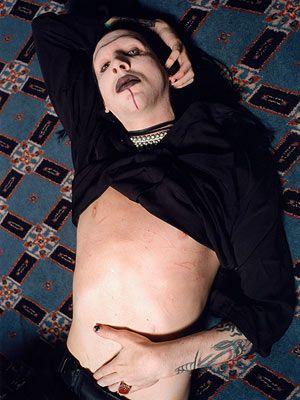
Up the stairs and into my room an almost naked Marilyn Manson calls me over and points to some books on the shelves over my bed. He pulls out one covered with satanic symbols, turns to a page and finds what he was looking for, an intricately illustrated demonic figure. He points to the page and then to the space above his heart, and then to that self-same space on my chest.

mm

Marilyn puts an arm around me, cradling my head with his chest and we lay back on my bed as his tattooist emerges from the corner with the loudly buzzing gun in one of his black latex gloves. He copies the image directly onto Marilyn, before me. It feels extremely sexual – I am uncomfortable and uncertain about what follows, but dismiss these feelings thinking that either way it’s pretty cool.

On the drive back from this festival a sudden commotion is diagnosed as the result of a flat tyre. We hop out and examine the damage.

… All of this I tell Noah as we drive to work. I have forced him out of bed very early to accompany me on my drive to work so that he can take the car back for me. A real beauty who would jump at the chance to play in someone else’s car.

I reward his kindness by telling him of the bizarre dreamworld I had inhabited moments earlier. This unsolicited monologue ends just as there is a loud crash and jolt, and the sound of metal grinding on concrete as we start to lop to one side. The giant pothole that I had not seen until too late has torn my tyre apart.

A few days later I wake to see a message from Noah at 2.30am, he is stranded on the way back from work. Two nails have puncture his tyre. The very next evening, at 1am, my colleague messages to say that she is stuck on the side of a road with a flat tyre.

A spooky coincidence that we all drive on the same fucking poorly maintained roads. I should start hovering.

Create a free website or blog at WordPress.com.

Up ↑