Fonotune: An Electric Fairytale (2019)

Written for RAF News June 2016

A rag-tag bunch of headphone wearing wanderers make their way across barren desert-lands to see the final gig of a retiring rockstar in the middle of nowhere.

Image result for fonotune

We first join mute drifter Mono, played by the film’s director FINT, and despite offering absolutely nothing – he will be our constant and surrogate. Along the way he bumps into a series of individuals all with the same purpose so they amble together in the same direction; and so must we. Rather than exchanging words, they each listen to their preferred radio station, the names of which decorate the screen with stylish typeface.

But despite the promise of music, the most prominent sound is of footsteps as our gang march through a largely empty frame, collecting members such as Stereo the Hustler (Yûho Yamashita), and Analog the Drifter (Kazushi Watanabe).

To call them characters would be a stretch – they are set apart by their clothes and choice of music, exhibiting one behaviour throughout, second always though to walking. The combination of slow, repetitive shots with an occasionally arresting composition combine well with the ambiguity if you have the patience, but this could very well be tested. These names too appear as well crafted title-cards, emblazoned across the screen like a Batman onomatopoeia circa Adam West.

Some details dropped along the way suggest FINT knows very well what he is doing and – there is a moment in which the gang stop to watch an impromptu performance by a band without instruments or amps, their thrashed enthusiasm heard only through comically muted twangs.

The few moments in which we are transported to the station FNTN where a futurist DJ is mixing live, the scenes come to life and the minimal aesthetic is elevated. It is frustrating that this isn’t used more, perhaps the fear is that it would feel too much like a music video. Instead we drift alongside the group in near silence, hoping for a pay off that will never quite take shape.
Shed of the Dead (2019)

Written for RAF News May 2019

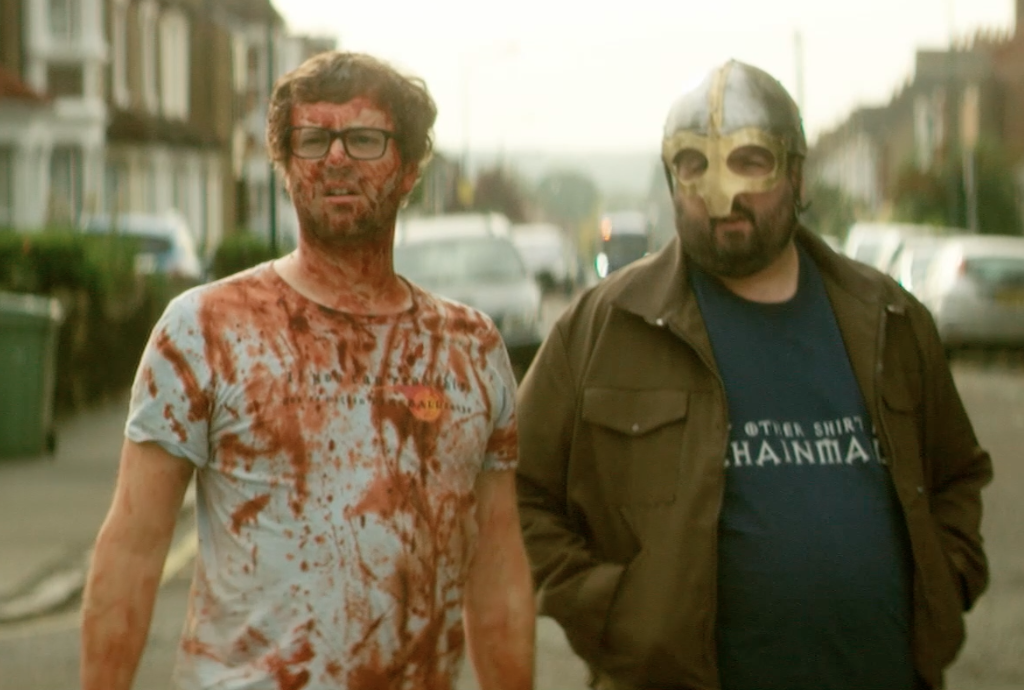
Trevor (Spencer Brown) spends his days in a shed on his allotment, painting miniature figurines for a fantasy role playing game, ignoring the reality of his unemployment by imagining himself a hero.

Image result for shed of the dead

Using this overgrown patch of land as a hideout from his nagging wife, distilling vodka from potatoes pilfered from his neighbours, Trevor isn’t popular. He is smug and condescending without a modicum of self awareness, refusing to get his allotment in order because gardening isn’t for him.

Cowardly and yet aggressively combative, his only friend Graham (Ewen MacIntosh) is an agoraphobe who shares his misplaced arrogance. But together they might be the only hope for humanity on the brink of a zombie apocalypse. It doesn’t get bogged down in explaining how or why, but the assumption is that we’ve all seen enough zombie films to get the gist; and we have.

The film has the most fun when it’s playing with special effects and make-up, but it does itself a disservice by creating a central character so loathsome that you end up routing for the undead. Although it is farcical, when Jeff accidentally kills a neighbouring gardener (Kane Hodder) in the opening of the film, and decides to chop him up to avoid suspicion, nothing supernatural has occurred. He is simply an unsympathetic and painfully unfunny sociopath.

As the title pretty much spells out, this English Zombie comedy is derivative, making references to films that are making references to other films, like a photocopy of a photocopy, losing trace of anything original or funny.

The bulk of the cast, including small parts for horror legends Michael Berryman and Bill Moseley, have seen there fair share of low budget horrors and zombie flicks – a sub-genre that has become so saturated that it is mentioned in the film itself, but that doesn’t mean it won’t keep coming back.

Sunset (2019)

Lazlo Nemes’ much anticipated follow up to Son of Saul is a slow, unravelling mystery set in Budapest 1913, a city rivalling Vienna in all splendour but with a tension bubbling beneath that has them on the brink of the Great War.

Sunset Movie Review

Irisz Leiter (Juli Jakab) arrives at a renowned hat retailer that by no coincidence shares her name. This store belonged to her late parents, from whom she was separated as an infant. Raised with impressive milliner experience, Irisz returns seeking employment and a connection to the family that she left behind. When she hears talk of having a brother, involved in a local scandal no less, she becomes determined to find out what happened, despite many wanting her to quietly leave town. None moreso than the current proprietor of Leiter’s, and yet through sheer will and stubborn determination she returns time and again, managing somehow to worm her way into a position and a place to stay.

There begins a pattern of Irisz having a door closed in her face, both figuratively and literally, only to find another way in, sometimes impossibly so. This she does whilst uncovering secrets that belie this establishment and the customer base of wealthy elites.

Sunset uses the same shooting style as Nemes’ previous film, following the central character and framing every event from her perspective, if not looking over her shoulder, looking directly at her face. Where Son of Saul had the terrifying urgency of a Jewish worker navigating through hellish layers of Auschwitz, the style choice is less obvious here.

Despite being in every shot of the film Irisz doesn’t give much away. This feels mysterious at first, especially with her magical ability to defy instruction and consequences, but no explanation makes her feel empty, if not a tad dense, in the end.

The camerawork, which has to be a focus-puller’s nightmare, grows tiresome with unclear intention, making events feel more contrived than they might have otherwise – conveniently stumbled upon like a kind of immersive theatre.

The drawn out pace and repetitive nature make it feel unnecessarily long, but it is a treat to look at regardless and you sit in constant admiration of its complex coordination.

Alien Addiction (2019)

Written for RAF News May 2019

Ignoring the conspiracies of his paranoid mother, stoner Riko (Jimi Jackson) stumbles upon an alien spacecraft in the woods and finds that they actually have a lot in common. That is to say: they are mind numbingly stupid and love to smoke.

Image result for alien addiction

These other-worldly beings have big blue heads, and shuffle about with their bellies pushed out. This they do whilst on the hunt for human excrement, which they see as gifts, to be smoked. When things couldn’t seem to get much more ridiculous, Riko befriends the aliens and helps them to chase this high whilst a conspiracy blogger hunts them down.

There isn’t much else going on in the small town of Waikato, New Zealand, nor is there in the film and yet it manages to run at an hour and a half. It’s a juvenile concept but the constant swearing indicates that it’s not meant for children, just stoners maybe, at least it couldn’t be accused of being pretentious. The characters of this film would enjoy it, but then Riko and his group are portrayed as half-wits with no aspirations.

The group of lads, who obsess over getting stoned and racing cars (in that order) to fast food outlets, serve the biggest opportunity for comedy but it’s not long before Riko parts ways with them to spend time with the idiot extra-terrestrials. Wearing costumes that don’t allow for expression leaves Jackson to do the heavy lifting, as it resorts to some basic visual gags.

Alien Addiction feels like Dude Where’s My Car?, or rather that it could have been conceived by one it’s characters, with a unbelievably silly story barely holding it together.

High Life (2019)

Written for RAF News May 2019

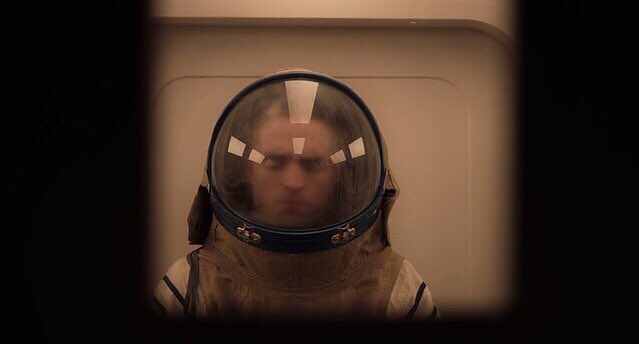
A lone prisoner aboard a spaceship takes care of a baby girl as his ship sets course for a black hole in this beautifully bleak but challenging film.

Image result for high life stills

Director Claire Denis has stressed that this is not science-fiction despite the setting. This is true in as much as it is focussed on the human story over special effects, but it is far from ordinary.

The opening features Monte (a tenderly detached Robert Pattinson) carrying out work on a rundown ship and tending to baby Willow (Scarlett Lindsey), sometimes at the same time. In this large vessel that has the isolation of Silent Running and the dirty futurism of Alien: they are alone. Single-fatherhood distilled to the elation of witnessing first steps to pleading for quiet in order to keep sane.

The initial meandering pace of High Life sets expectations for a slow meditation on the human condition, when in fact it will explore this territory but by means of a darkly tense prison drama that tips occasionally into horror and eroticism. Cutting back in time we learn about the purpose of this ship and what happened to the crew before catching up with Monte and Willow much later.

This was a penal colony for death-row inmates who had volunteered for a suicide mission to harness the power of black-holes for Earth. Along the way however they get tangled into twisted experiments of reproduction. This additional research is all under the command and control of Dr. Dibs (Juliette Binoche) who brags of being the only criminal onboard worthy of the name. Combining scientific garb with a waist-long braid she is positively witchy, keeping the others sedated and giving them drugs in exchange for their participation.

A noteworthy scene sees Dr. Dibs strapping herself into the ‘fuckbox’, an isolated cubicle that appears to simulate and stimulate simultaneously, bringing out erotic visions and sensations. Shown within a vacuum, this bizarre sensuous experience is powerful and enveloping.

The film seldom leaves the confines of the ship, and when it does it’s to mysteriously vague memories washed out with 16mm grain, creating more questions than answers, which can frustrate or delight.

Awash with mystery and symbolism High Life climbs inside your head and challenges you to make sense of it, and I accept the challenge gladly.


Create a free website or blog at WordPress.com.

Up ↑