Jarhead 3: The Siege (2016)

Written for RAF News May 2016

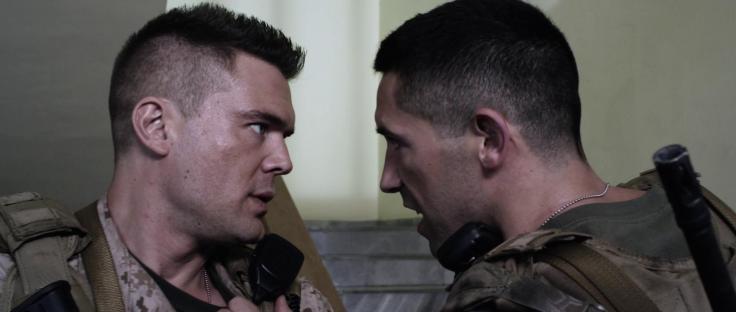
Corporal Evan Albright (Charlie Weber) is a Marine with high marks and the newest to join the forces at the US Embassy in an unnamed Middle Eastern territory, but his goody-two-shoes keenness will make him enemies before he can warn them that the Ambassador is under threat.
vxpymee

Shown through the compound and assured of its high level security, the films subtitle connects the dots for you if you hadn’t sussed it already – they’re not as secure as they think. Outside the gates are some local protestors and one particularly shady looking guy (Hadrian Howard) with ties to Islamic State can be seen with a camera focussed on the guard tower – this doesn’t look like a broadcast for Al Jazeera, at least Albright doesn’t think so.

The new recruit’s standalone attitude is his weakness, looking out for himself and ‘killing’ his entire squad in a training exercise so that when he finally has cause for concern no-one cares to listen. They see him as a hot-shot, John Wayne, but he’s more like John Cena, the professional wrestler turned actor – cartoonishly American in looks and attitude: pronounced chin, inflated features and patriotic to the point of ‘pissing red, white and blue’.

With an extremely simple story, loosely based on the Benghazi attack of 2012, it is coloured in by out of place dialogue that jumps from soppy inspirational lines to throwaway quips. In amongst the Yanks are a few Brits affecting accents – the standout performance being that of Scott Adkins as Gunnery Sergeant Raines, the badass of the bunch who proves himself handy with a sniper rifle.

Once the Embassy is inevitably breached, cue endless shots of scarf-clad terrorists folding like rag-dolls under gunfire. With a bodycount so high that it gets boring, Jarhead 3 couldn’t be more different from the first in the franchise, which made a point of showing very little action. A very standard film that does exactly what it sets out to do, kick terrorist ass and chuck in in the odd buzzword to make it relevant #Oorah.
Adult Life Skills (2016)

Written for RAF News April 2016

Stitched together from parts of writer director Rachel Tunnard’s life, save for the serious parts, Adult Life Skills is a piece of handcrafted whimsy that has heart and a whole lot of gags – that most of them don’t land doesn’t detract from its Northern charm.

adult_life_skills-1000x600

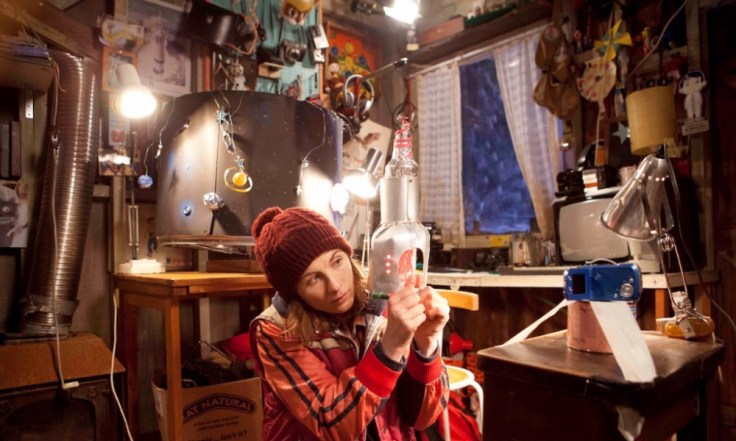
This low budget English film follows Anna (Jodie Whittaker) on the brink of turning thirty but still living at home with her mum (Lorraine Ashbourne), well almost – living in a shed at the bottom of the garden. This is her hideaway, adorned with pun-based signage (Right Shed Fred, Shed Zeppelin) and pictures of Patrick Swayze, where she makes internet videos of her thumbs for no-one but herself.

From her bobble-hat, bmx and back-pack it is clear that Anna is stuck in adolescence. She longs for the company of her deceased twin brother, and refuses to take life seriously without him. Anna remains a lonesome teenager and it is only when an old school friend (Rachael Deering) comes to visit, and as she spends more time with an outcast neighbourhood kid with an equalled sense of alienation (newcomer Ozzy Myers), that the full extent of her grief comes into focus.

Beneath her quirks Anna is shown to be stubborn, defensive and full of rage, which is well captured by Whittaker. The film comes off as a bit too cute and reaches too far for it’s dramatic moments- it is only in the fleeting moments with over-looked love interest, the soft-voiced but definitely not gay Brendan (Brett Goldstein), that the awkward comedy works. The funniest back and forth though, occurs between the crudely penned faces on Anna’s thumbs.

Adult Life Skills has charm but it feels empty and unrealistic, like Me and Earl and the Dying Girl but hollow and without the pathos. It employs the same staples of the indie-twee and ends up as nothing special, but it’s hard to dislike – a low budget effort from some female voices that deserves to be supported.

One thumb up, and the other eternally depressed.

Despite the Falling Snow (2016)

Written for RAF News April 2016

Taking place during the height of the Cold War, Despite the Falling Snow follows the relationship between rising Soviet politician Alexander Ivanov (Sam Reid) and the new love of his life Katya (Rebecca Ferguson), an entrancingly seductive Russian spy who gets a little closer than she intends to, falling for her target and jeopardising her mission.

This story is intercut with Alexander decades later in New York, now played with authoritative command in Charles Dance, as his niece Lauren (also played by Rebecca Ferguson) plans a trip to Moscow to exhibit some of her political artwork including a portrait of the woman who shares her likeness. Here she will end up uncovering some of her uncle’s past, finding herself tangled up in the same web of lies and deception, before finding the truth of what happened to Katya back in 1959.

Adapting her best-selling novel for the screen and directing herself, Shamim Sarif brings sensitivity and tenderness to the relationship of Alexander and Katya. Particularly in the character of Alexander, played by Sam Reid as broad-shouldered and square jawed but gentle and naive. At first it seems like this doesn’t match the character at all, at least not how Charles Dance plays him later in life, but it becomes clear that this softness of touch is defining of Alexander’s sensibility and ultimately his undoing.

Perhaps down to the adaptation the dialogue is often clunky and unnatural, and though it can a sometimes feel like a television drama the story of these two lovers tied to opposing forces is compelling, with twists and turns in both timelines. The performances are befitting of their characters, especially a vodka-soaked cameo from Anthony Head which shouldn’t be missed.

Disorder/Maryland (2016)

Written for RAF News March 2016

Back from service in Afghanistan as part of the French Special Service, Vincent (Matthias Schoenaerts) shows signs of post-traumatic stress and so finds some private security work before he can return – if he can return. His judgement seems to be clouded though by his apparent disorder as he struggles to tell apart real threats from paranoid delusions.

screen-shot-2016-02-09-at-20-26-18-e1455049833503
“A lot like Nicholas Winding Refn’s Drive but takes itself very seriously.”

Vincent is a brooding figure who shows little more than his vigilant drive to protect. The first half of the film is an interesting and stylised exploration of his state of mind in which we experience a job from his perspective. Hired initially as security for a wealthy Lebanese businessman who is hosting a party, we observe potential threats whilst the overpowering bass of dance music drowns out all voices and throws your focus.

The use of penetrating sound and the uncomfortably closed in shots of Vincent’s face as he stalks guests through the crowd works well to overwhelm your senses and create palpable tension. This discomforting paranoia will plague the entire film and create some extremely suspenseful scenes.

Schoenaerts is great without even having to speak. He acts with his body, showing a raw animalistic quality that has him physically restrained until he can find an outlet. He is threatening, even to the family he is hired to ‘babysit’ when the businessman leaves town. It is only when Vincent is left alone, protecting the client’s wife (Diane Kruger) and son that the threats seem to become more real, but how certain can he be?

At first it feels as though Disorder will be a thoughtful but very different take on PTSD. But this message is abandoned half way into the film as it quickly becomes more of a genre film, an action thriller. It remains stylised and tries to hold on to the drama but it becomes almost a horror film by the end. As a result the message of Disorder is lost, albeit to very tense and involving action.

disordersodadistributor

This sudden plummet into a different genre changes the way in which you view Vincent and ultimately it creates a very unclear message. In ghost films there is often a character who warns everyone else, who senses a presence and is usually laughed at until the doubters are mutilated by said presence. The film aligns with this position because the idea of there not actually being a threat is less interesting for this kind of film. In Disorder, Vincent senses ‘the presence’ but it is clearly fallout from his PTSD, until it isn’t. Until the point where his paranoia comes true. I am not sure what is to be inferred by this? Is his disorder practical? Does he even have a disorder or is he just some clairvoyant Jason Bourne? It seemed like a cheap way to cash in on the tension created up until the last act. A cop out from creating non-action drama.

Even still the film was different enough to be compelling. The style was interesting even if there weren’t many realised characters or much of a story. It felt a lot like Nicolas Winding Refn’s Drive – a taciturn father surrogate brutally kills bad guys with supposed moral justification, shown with European flare through the striking visuals and an important score -but Disorder seems to take itself more seriously, pretending to be something more, something deeper… for an hour at least.

The Ones Below

Written for Film and TV Now Nov 2015 (Available here)

From the haunting lullaby that accompanies the opening image of a sonogram, there is an immediate sense of foreboding horror in The Ones Below, of something about to go wrong.

tumblr_ntm2uhvwht1qav8uzo1_1280

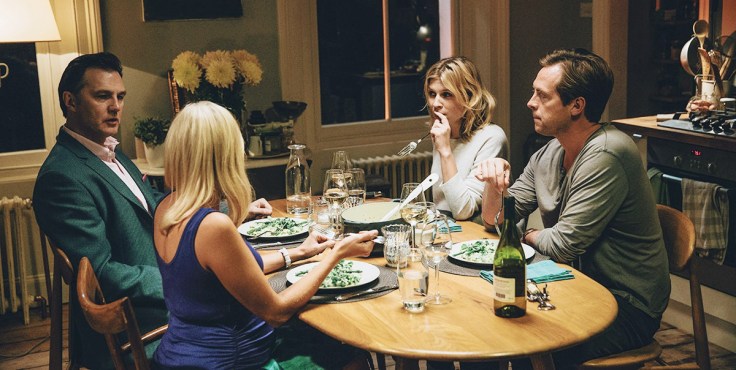
The expecting couple are young professionals Kate (Clémence Poésy) and Justin (Stephen Campbell Moore), who up until now lived comfortably in the upper half of their London flat. Downstairs a new couple have moved in, a bubbly Finnish woman (Laura Birn) and her older, much less congenial husband Jon (David Morrissey). As luck would have it they have a child on the way too.

The soon-to-be mothers are drawn together initially but their differences soon come to light. Kate has doubts about motherhood that are not even comprehended by her desperately maternal neighbour. Theresa (her name even reminds of the renowned ‘Mother’) and Jon have always wanted to have children but it hasn’t been so easy for them. This is in stark contrast to Kate who wasn’t sure that she even wanted to have children, perhaps seeded in the frigid and distant relationship she has with her own mother. The ease with which she has fallen pregnant becomes a matter of discord as a sudden and dramatic turn of events sends the couples’ relationship spiralling into paranoid contempt.

When Kate eventually gives birth, her reluctance is challenged by the relentless demands of her young baby. She soon finds herself sleep-deprived and strung out, suspicious that the couple downstairs are interfering, but how much of this is in her head? While the more villainous qualities of certain characters is shown as schlocky and over-the-top, even for this style of film, it is the more subtle performance of Posey that grounds the horror and creates something interesting.

The Ones Below cleverly uses the divisive attitudes towards pregnancy as a means of finding tension and dividing lines. This is brought out in the way each character dresses, and the ways in which they decorate their apartments even. Where the more laid back and career focussed  young couple wear mostly monochrome, smart-casual attire, the ones below are splattered with bright garish colours, a quality which is unsettling, almost laughably so in the case of Jon, whose tall and imposing demeanour is undercut by his pink socks.

The on-the-nose title of David Farr’s directorial debut sounds like A Twilight Zone episode, which is rather fitting for this film which owes a debt to the twisty revenge thrillers of decades past, and not to mention Roman Polanski. Not simply Rosemary’s Baby, which is an undoubted influence, but the others in the Polish director’s Apartment trilogy, and his more recent adaptation Carnage, which examines the volatile dynamic of two middle-class couples as they fight over their children.

Although there are glimpses of these other films, The Ones Below lacks the potency to rival them and instead offers a cheap thriller that descends into pure absurdity. The final act is actually quite fun in the end but it comes at the expense of all seriousness up until this point.

Blog at WordPress.com.

Up ↑