HTTYD2 or: How I Learned to Train My Dragon and Love the Bomb

I sit nervously waiting with three other journalists in a suite of the Soho Hotel. Having just seen a preview of How to Train Your Dragon 2 we await writer/ director Dean Deblois for a roundtable interview. This is immediately before an interview with Cressida Cowell, the author of the series of books from which the films were inspired. We make some stilted conversation when I learn that these professional writers are all in fact parents. I was not a parent at this particular juncture and so felt that they already had a deeper connection with the film, this along with the publications they represent: one writes for a literary magazine aimed at young and aspiring authors, one an esteemed nature magazine, and the other writes about families… or something. My focus is elsewhere at this point as I can’t shake the feeling that I don’t belong here. I seem to echo their own bafflement when I tell them I’m writing for the RAF… “I guess they like things that fly”.

httyd2 poster
Look how happy everyone is…

How to Train Your Dragon, I realise whilst watching the night before the event, has a strong anti-war message. Not only that, it uses planelike symbols as the threat – spraying fire onto the village where civilians live. Maybe the anxiety is kicking in but the message is definitely there. I admire the film for this reason though I could do without this feeling, knowing that I am attending this event as the villain. Continue reading “HTTYD2 or: How I Learned to Train My Dragon and Love the Bomb”

Locke (2013)

Ivan Locke (Tom Hardy) must juggle the collapse of his marriage, pacify the pleas of the woman about to give birth to his child, and oversee the preparation of a job that he has just left behind in order to be at the hospital – all of this he must do on the drive from Birmingham to London constrained to the phone in his car.

LOCKE

Ivan is a level-headed pragmatist whose efficiency is the evident force behind his success as a construction foreman. Though now, due to a one night stand with a woman he felt sorry for, he decides to be present for the birth, which means abandoning one of Europe’s biggest ever concrete pours for the base of a skyscraper. All we see of Ivan is how he interacts with others over the phone; how he deals with mounting levels of stress from all directions. Somehow – under the weight of overlapping crises – he maintains a rational distance that allows him to remain in control, even as events tear away from him and spiral.

Ivan shares his name with the Enlightenment age English philosopher John Locke, who supported the theory of the tabula rasa, or: the blank slate. This theory proposes that humans do not have inherent or innate qualities, that they are instead shaped by their own experience. In the case of nature vs. nurture the blank slate supports the latter. This is the defining feature of, and prime motivation for, Ivan. Between phone calls he is caught arguing with the spirit of his late father, raging at empty backseat through the rear-view mirror, as though he is being beckoned from beyond the grave to become a failure and a bad father. Ivan uses this fury as fuel to break the cycle of nature – to prove that he can decide his own fate and straighten the family name. Not only does he decide to be present for the birth, but he tasks himself with overseeing an enormous job that he will likely be fired from anyway. This does not matter, Ivan has set a precedent of loyalty that transcends the divide of business and personal, significantly painted with the metaphor of laying the foundation of a building. But as he states himself of the skyscraper, if cracks appear at the base, support is compromised and it becomes a threat.

Like the eponymous character, we too are locked in this situation; trapped in this single location for the journey. However, the film seems to not only be aware of this, but weary and apologetic, as it aims to keep things visually interesting by constantly cutting to external shots and various distracting angles. Shooting the entire film from start to finish in one take (or 37 minutes due to the capacity of the memory cards) and repeated two or three times a night for 6 days, the performance naturally has tension built into it’s construct and thus holds a pressure of it’s own. When permits to film on the M1 were revoked at the last minute, it is as though life was imitating art and echoing Ivan’s struggle to arrange road closures. Not only that, but the cold that Locke suffers is actually Hardy’s; the frustration that bursts out of Locke in reaction to the call waiting alert is Hardy’s too – actually reacting to the petrol gauge as it interrupted the drama and altered later in post-production. The tension of the film is palpable as it is, to some degree, real. buried Buried (2010), the single-location thriller released a few years prior, had a similar concept and incorporated a similar style, with sole actor Ryan Reynolds buried alive in a coffin experiencing a more life-threatening stress whilst other characters appear as voices in phonecalls. Focussed on a more extraordinary situation, this Hollywood film is suitably made into a spectacle through it’s set design which allowed this minimal space to be transformed. Locke, which is so gripping for its realism and its nuanced performance, does not need this escape or stylism. There is enough movement in frame to keep the your attention and Hardy offers a captivating performance in the subtlety of his acting: each micro-expression magnified by the intensity and intimacy of the camera. When Ivan first smiles it comes as a relief, it feels sincere and hard-earned and so we experience this same satisfaction. It seems that this could have all been heightened if the direction hadn’t taken attention elsewhere – it was as though the film’s strength was being treated as it’s weakness, and so it missed out on the payoff of its bold simplicity if it had simply let the action unfurl in longer, uncut takes. That being said, the tension is inescapable still, and the film is undoubtedly ambitious as it is. An impressive film that shows the capacity of film to do so much with so little.. and Tom Hardy.

Foreground Noise

Here be a compilation of clips focussed on the unreality of reality television.

I grew familiar with the format of reality television since it was always on at home. This was before I matriculated, studying film and learning more about the processes in action, the tricks of the trade. This was all occurring during the surge of reality TV. So when I returned home three years later, I could no longer watch this predominant kind of programming in the same way – the seams were beginning to show.

It was as though it had become it’s own type of media, a disposable form of television that wasn’t made to be watched again, that didn’t require your full attention. The televisual equivalent of fast food. An excused guilty pleasure that isn’t intent on filling you up, so it could blamelessly leave you empty and craving more. Chewing gum for the eyes that tricks you into thinking you’ve seen something when really you have done fuck all. A type of show that acts as a sedative, that you switch it on in order to switch off.

It’s just something to put on in the background, I was assured. But how something so vulgar could be overlooked was beyond me. What was a box in the corner before I left home, had been rolled flat, now a light-emitting window that all the furniture was angled towards, screaming for attention. A tad overpowering for a visual-soundbed. A high-definition realer-than-reality image that seemed to spurt out this hyper-real imagining of celebrities performing amateur sports, ordinary people in talent-shows, and then constructed personalities in ordinary situations. Baffling and bizarre, and none of it real.

Wrestling with Reality

As a wee nipper I was a big fan of wrestling. That is to say watching professional wrestling in the form of the World Wrestling Federation, for I possessed very little charisma at this young age and had no signature prop.. I had a snake named Jake in honour of the wrestler, but had no such moustache; I had a parrot named Colin after no-one in particular, but had no golden jacket. Though I was a child, a newly-formed and lesser-intelligent human being, I had started to wise up to the construct of wrestling and believing it to be fake my interest waned. My parents, quick thinkers as they were, taught me that wrestling was indeed fake but often enough it would ‘go real’ when someone pissed someone else off or something. So I would be sitting watching casually when my dad would announce ‘It’s gone real! It’s gone real!’ I would leap of the sofa and stand in front of the television transfixed, watching these actors really go at it, fighting within the fight.

jake the snake1000x1000

I still watched wrestling for many years after, even when I knew it wasn’t a real undertaker with a real grudge against his real half-brother. I watched it for entertainment. It was hyper-masculine dramatism akin to theatre within a sports league. Characters in costumes each given a narrative to follow, a path to tread that would lead them to be supported by or taunted by the crowd: good, evil or underdog. An operatic UFC. In some ways boxing appears to tread this same line. The drama that surrounds the fight can become the focus, from tabloid fodder to pre-match hype that may simply be promotional but appeals to our innate desire for story. Continue reading “Wrestling with Reality”

Prolonged Sentence

When I was a teenager – old enough to know better but young enough to be a bit of a prick despite the fact – I pulled what I thought to be a harmless prank, thinking it would get me out of some schoolwork. Instead it took me deeper than I could have possibly imagined and taught me something about social constructs that effects me to this day.harry-houdini

Once before in school, when I felt unprepared for a French oral exam, I took an impromptu sponsored day of silence. I told a couple of friends to explain this to everyone, Mademoiselle in particular. The pièce de résistance: a note scrawled on the front of a ‘donations’ envelope that would serve as a prop that I could carry around as testament to my lie. I didn’t raise any money but this didn’t matter – I had gained another day of revision. Success.

Confirming my ability as an escape artist, I took it as a challenge when one day a new substitute teacher announced that we would each have to read our work to the class. Though I would often take on the role of the clown, I feared the spotlight when it was out of my control. This underlying nervousness paired with the unfounded confidence provided by my previous scam, led me to take extreme measures to avoid reading out loud. I made my decision and began to warm up for what I was about to do.

Apparently unfamiliar with how classrooms work when under temporary supervision, all of her questions became rhetorical. She was a new face, soft featured with a suitably friendly demeanour. She wasn’t going to get anything from us. Staring out into the silence, she took extreme measures herself and started to pick on people to answer – a pretty uncouth course of action that wasn’t going to make her any friends. The immediate response to a teacher who employs such a technique is to avoid eye-contact. So head-down I stared at my empty page and waited to hear my name called, preparing to make an emergency change to the plan. Then the inevitable – “You there”. Evidently she didn’t know my name. Someone nudged my shoulder as I settled into character. This was happening. I slowly looked up from my book, nervous and hesitant, when the words stumbled out.

“I.. th..thh. I think that from from fromm the book, from the the…”

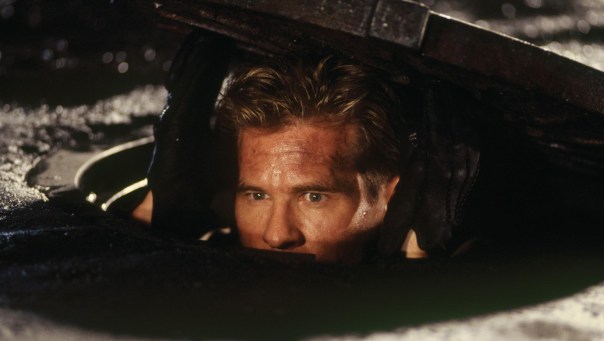
Each cluster of stammers was broken with a deep sigh as I seemed to refocus and overcome frustration with myself. People had started to turn and face me and as soon as I started to talk again, in broken sentences, they began to laugh. My ruse was up. Or at least I thought it was until their sniggering was silenced by the now stern substitute. Then she encouraged me to carry on… Yes. This was working. “I’m s-sorry” – more laughs from them, more empathy from her. They were all playing into this perfectly. In becoming the timid and tormented I had gained power over them all; they were all part of my game now. The substitute excused me from having to finish my answer and she wouldn’t ask me to read out anything again. I had won, for now at least.the-saint-(1997)
At the end of the lesson she asked me to come and join her up front. I sat at her desk whilst she asked if I was alright, if people had always laughed at me. Panicked and nervous, the stutter became easier to contrive, though I said very little and convinced her I was okay. I was more than okay, I was a genius puppetmaster, but now all I wanted was to get out the room and be myself again. I was starting to feel claustrophobic inside this act. Finally she let me go, so excitedly I returned to the kudos of my peers. Not only had I avoided genuine failure, I had won over both sides – nurtured by the teacher and heralded by the students.

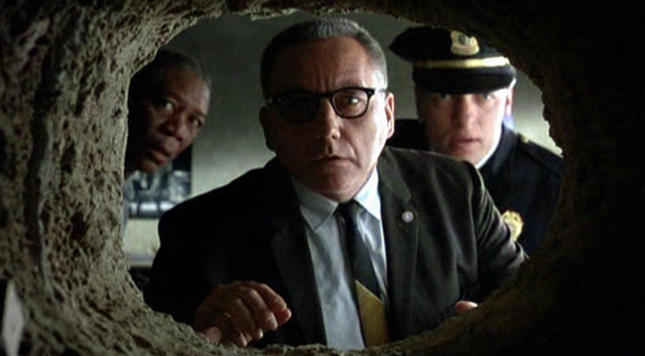
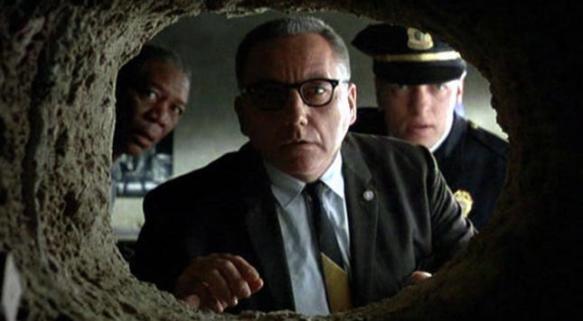
It must have been on everyone’s mind the next week when we had the same class, as those already seated welcomed me through the door with reminiscent smiles. The afterglow of my actions lingered on and my legacy was being born. I couldn’t help but feel puffed up by this, though obviously I tried to not let it show. As I found my place I realised that those knowing smiles knew something that I didn’t. A wave of terror engulfed me as I looked up at the tender, understanding eyes of the same substitute teacher. Her again. There was no escape. It would soon be revealed to us that our regular teacher was actually on maternity leave, meaning: 6 months with this substitute. 2 terms with this fucking speech impediment. the-shawshank-redemption-1994-02-645-75 I needed a way out. Ironically enough this was what landed me here in the first place. I prided myself on my ability to get out of things, so I thought fast and settled on a plan to phase it out. The next few weeks would contain some of the most stressful days in my adolescent life as I would experience the overwhelming anxiety of anticipation before this particular class. I would prefigure my approach to talking – essentially rehearsing how to sound nervous. On top of this I came up with back-up excuses and fail-safe plans. In avoiding petty work I had created a true mission for myself – trying to avoid reading aloud for fear of the pressure and attention, I had made myself the focus of every class as people would sneer and openly comment on the ironing out of my stutter. I had become trapped in a prison of my own creation, and decided to follow in the footsteps of Andy Dufresne, clawing my way out inch by inch with a measly rock hammer. Eventually I’d be free, but I would be changed by the experience.
In this brief window I had acquired and overcome a disability that many have for life, though I’m assuming most sufferers didn’t adopt it voluntarily in order to manipulate a situation.. (I am reminded of Derren Brown’s head-nodding-tic which he did in fact bring on himself through relentlessly trying to persuade people as a hypnotist at college) In half a year I had experienced new depths of anxiety that would make me all too aware of the power in perception and persona. An awareness that has become a true affliction.. but more on that another time.

Create a free website or blog at WordPress.com.

Up ↑