Tried to make a short one I did.
Then tried to make it shorter, as a short.
Bit much maybe.
some words. often too many.
Tried to make a short one I did.
Then tried to make it shorter, as a short.
Bit much maybe.
Written for RAF News May 2024
Freshly released from jail in Tuscany, an Englishman wanders back into the company of his friends, a disreputable but loving gang of grave-robbers lead by his uncanny gift for dowsing.

Arthur (Josh O’Connor) has an aura that attracts people, this in spite of his demeanour which is largely aloof if not cagey. Grieving the loss of his girlfriend and without a job or place to go, he finds himself staying with the mother of his absent partner Flora (Isabella Rossellini) in a ramshackle palace frequented by her army of daughters, as well as Italia (Carol Duarte), one of her least talented students.
Tone deaf but undertaking vocal coaching, Italia stays in the house, curiously observing Arthur and carrying out the housework apparently in aid of her tutelage: “to exercise the voice, you must first exercise the body”. A convenient method of teaching that saves Flora from having to pay a maid.

With segments shot on 16mm, or in a wacky altered frame rate, La Chimera has many playful affectations but it never feels forced. Classical music provides interstitials filled with cutaways that are observational and dreamlike, like long-forgotten memories. There is a vibrance to the picture, not only in its colour but in the life that it depicts. Each character with their wild uniqueness emerges naturally from this world, which in case you were interested is the small commune of Riparbella sometime in the 1980s.
Just like his grave-robbing gang – the so-called ‘tombalari’ – desperate to have Arthur’s guidance, pointing the way to underground chambers filled with undiscovered relics, La Chimera is funny and charming. In fact their humour and attitude is deeply infectious, and it is a pleasure to spend time in their company. A wondrous and whimsical experience.
Written for RAF News April 2024
Two Senegalese teenagers risk life and limb to travel across dessert, ocean and hostile territory to get to Europe, where they think their dreams will be realised.

Seydou (Seydou Sarr) lives with his mother and sisters but spends most of his time with cousin Moussa (Moustapha Fall). They play football, exclusively wearing an assortment of faded European team’s kits throughout the film, but their passion is in music, which they write and perform together a cappella with friends on the street.
Though the two boys seem happy with their lot, buzzing with a contagious cheerfulness, they have been sneaking out to work on the sly, stashing away earnings until they have enough to runaway from home, and embark upon an impossible journey to Italy – entrusting their lives to various criminals and gangs who promise anything for enough money.
Matteo Garrone, the film’s director is Italian, and so the motive here seems pretty clear: not only to humanise the immigrants that arrive in the country, but to appeal for empathy on what we will soon learn is a death-defying journey where practices of kidnapping, torture and slavery are commonplace.
There is a rich and diverse score to Io Capitano, which at times carries a bluesy soulfulness that can fill you with hope for what could be the adventure of a lifetime for two young boys. This will grow darker as the reality sets in, but it never loses its rich, West African voice.
The heart of the film lies with Seydou, who appears in turn confident and fearful, uncertain of the huge decision he is making, but able to focus on the hurdle that lies directly infront of him. Although it could be easy to make this a bleak and gruelling watch, Sarr’s performance along with the film’s tone, makes this thrilling and hopeful.
Written for RAF News February 2024
A defiant relationship between a Jewish woman and a member of the British Palestine Police Force is at the heart of Michael Winterbottom’s political thriller set in late 1930s Tel Aviv.
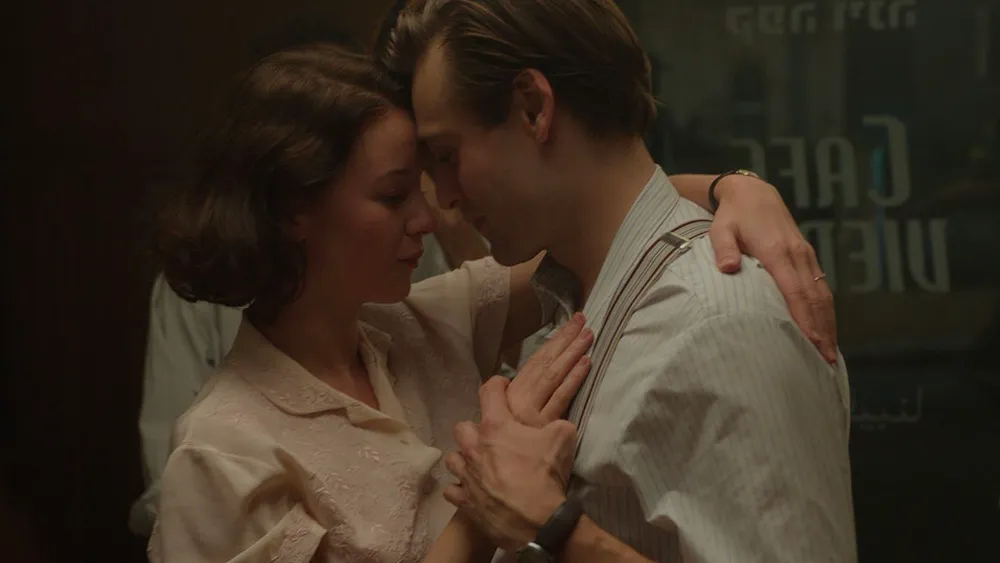
Based on real people and events, the backdrop to the romance between Assistant Superintendent Thomas Wilkin (Douglas Booth) and journalist Shoshana Borochov (Irina Starshenbaum), is the violent foundation of the Israeli state during the British Mandate of Palestine. At a time when Jewish immigrants are seeking refuge from Nazi-occupied countries, and the division between Arab and Jewish populations is becoming more pronounced, British forces are tasked with containing radical extremists. Acts of terrorism are growing in size and severity, presenting ideas and imagery that resonate with the ongoing Israel – Hamas conflict.
Shoshana is the daughter of a revolutionary Marxist Zionist, and a member of Haganah: an underground territorial defence force that advocates for the creation of an independent Jewish state. Wilkin is shown to have embedded himself into the community, earning a mutual trust that is abandoned by the new Superintendent Geoffrey Morton (Harry Melling) who intends to snuff out the Jewish independence movement, despite their wish for peace. Forcing Tom and Shoshana into opposition, their relationship looks to become just another casualty in this enveloping war of ideals.
The shooting style and editing pace do well to suspend you in uncertainty, as the ticking time-bomb of political unease is probed in the hunt for Avraham Stern (Aury Alby), leader of the Zionist paramilitary organisation Irgun.
Intended to show how political extremism forges enemies, even of lovers, the tensions of the relationship are symbolised in the warring factions of the region, however the combat makes the quarrelled love affair feel trivial by comparison.
Despite shifting focus the final act of Shoshana is thrilling, and though it has been a passion project 15 years in the making, it is unfortunately more relevant than ever.
 samcooney