Under the Skin (2013)

Written for RAF News Jan 2013

Scarlett Johansson assumes the role of an alien in human form that observes the surrounding life in Glasgow; stalking and seducing understandably eager young lads and trying to understand what it is to be human. Director Jonathan Glazer, who debuted with Sexy Beast, returns to cinema with his first film since 2004: a conceptual science fiction that can at times become hard to watch.
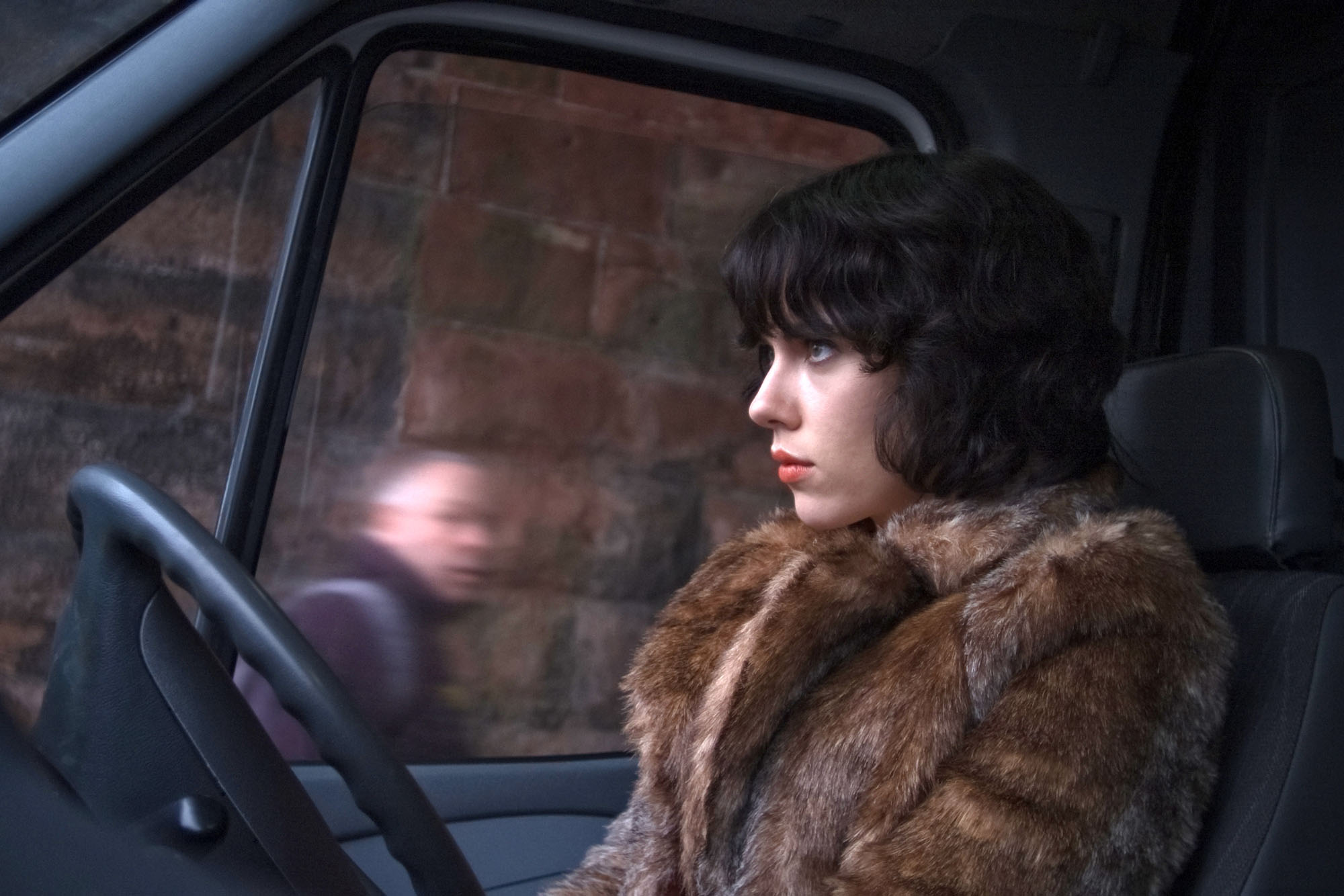
Film Review Under the Skin

Under the Skin is shot primarily through a series of hidden cameras that capture Johansson observing and interacting with the real townsfolk of Glasgow. We are thrown deep into the overwhelming sensory experience of shopping centres and crowds leaving a football stadium. Having adopted the voyeuristic alien’s perspective, these familiar experiences, accompanied by amplified sound, can be just as unsettling as the more experimental style that will endow the more sinister elements of the film. Implementing a style that intends to immerse and unsettle, Glazer effectively blurs the line between film and reality.

This siren like alien drives around in her van, a score of screeching drones foreboding the fate of the horny Glaswegians who enter. Forward and alluring, paired with the fact that she looks just like Scarlett Johansson, this succubus gives the young men very little chance to escape: seductively undressing  and coaxing them to a rather surreal demise.

The jumps from documentary style footage to the constructed scenes that feature more abstract visual effects, align you with Johansson as you become alienated and long for something to hold onto. There is not much dialogue and, with a central performance that is intentionally rigid and non-responsive, the film can drag along at times, particularly in the second half.

Under the Skin is a little more experimental in style, but it is truly an original film with moments of utter brilliance.

What’s In a Name? Decoding the Ambiguity in Martha Marcy May Marlene

Martha Marcy May Marlene (2012) looks at fragility of the human mind and how it can be manipulated, in the process contorting personality and identity. It follows a young girl as ideals are imposed on her from conflicting perspectives of consumerist society and counter culture community – ultimately fracturing her sense of self. The following analysis will look at the crisis of identity that is titled in the film, as Martha becomes Marcy May and finally Marlene.

martha_marcy_may_marlene_movie_image_elizabeth_olson_01

Martha (Elizabeth Olsen) is a young girl who, along with her older sister Lucy (Sarah Paulson), had been abandoned by her father after the death of their mother. Seeking refuge and a new family she joins an alternative community in the Catskill Mountains of New York. The film begins two years after this induction as Martha flees the commune to her sister’s scenic lakeside retreat in Connecticut – her personality fragmented by her abusive experience.

Continue reading “What’s In a Name? Decoding the Ambiguity in Martha Marcy May Marlene”

The Scorpion and the Frog: The Fable of an Anti-hero in Drive (2011)

Edit: Condensed the analysis into a video here

Faced with a river, a scorpion enlists the help of a frog to ferry it across the water on its back. Fearful for being stung, the scorpion explains that if it were to sting the frog they would both drown. Alas, halfway across the river the scorpion stings the frog. As they begin to sink to their death the frog asks the scorpion why it had doomed them both, receiving the reply that it is in its nature.

The broken halo of a violent hero

Ryan Gosling plays the part of a nameless Hollywood stuntman/ mechanic/ getaway driver turned breadwinning moral avenger in Nicolas Winding Refn’s Drive – subverting the strong-silent type of classic cinema and, like Refn’s Valhalla Rising and Bronson, calling into question the nature of violent heroes on screen. The following analysis will examine how the hero of Drive is made to appear reserved and unpredictable in an effort to make him unknowable – but really how his actions are undermined by his childlike sensibilities and confused sense of self.

Fuckers Who Kill People For Money: The Unsentimental Portrayal of the Hitman in Kill List

KillList

The hitman has become a cultural figure that has undergone various aesthetic and moral transformations in cinema. The most typical and somewhat surprising characteristic of the contracted-killer is that he or she is shown to be a solitary figure worthy of empathy or even admiration; a sleek and often charming loner that the story is attracted to – suspending the audience’s judgement or allowing them to explore his/her inner conflict in order to understand their motivation or veiled humility. Amongst his description of the subcategories of hitmen in his chapter of ‘Crime Culture: Figuring Criminality in Fiction and Film’, Andrew Spicer describes the aestheticised version of the hitman as the ‘Angel of Death’: “a highly masculine fantasy of total self-sufficiency”. This increasingly recognisable antagonist and the subsequent notion of fantastical perfection is precisely what Ben Wheatley challenges in his latest feature – Kill List (2011).

Continue reading “Fuckers Who Kill People For Money: The Unsentimental Portrayal of the Hitman in Kill List”

Blue Valentine and The Christian Right

Blue Valentine is a contemporary take on a romance that explores the deterioration of a marriage by jumping through time to examine moments throughout the relationship.

blue valentine

The inevitable failure of the marriage is undoubtedly pinned on Cindy (Michelle Williams), whilst Dean (Ryan Gosling) collects the empathy of the audience. The film opens with Dean displaying a sincere, everyman charm before befriending colleagues and then displaying his lovable treatment of old people. This is juxtaposed with a stone faced Cindy who is shown annoyed at the prospect of fun, before killing the family dog. I hope that my own inherent gender is not the reason for siding with Dean at this point. However, there is a recognised tiredness to Cindy, so following the non-sequential structure of the narrative, there is an expectation of explanation – for a moment which explains or contextualizes her behavior.

The following scenes reveal the moment in which they first meet – Dean exercises his charm and sense of humor, whilst Cindy deals with her  current, disagreeable boyfriend. It is once Dean has been established as the point of empathy, and the character who holds onto his sense-of-humor, that he exercises a subtle conservative, albeit loose, ideology. When they first talk at length on the bus: Cindy tells a dark joke about a child molester. Dean smiles playfully but confesses he does not find it funny – although he is playful, his comment on his taste appears sincere.

Gosling displaying his screen-permeating loveliness

When looking into their future – in an aptly named ‘future room’ of a sex motel, Dean lays bare his want for another child. The audience are aligned with the male position, almost pit against the female. He explains his discovery of fatherhood and his ever delightful concept of family, whilst she appears to act as a mother out of necessity. The sentiment of Dean is not forgotten shortly after when they proceed to have sex. Cindy insists on a rough form of intercourse, in which she is dominated. This is cut short when Dean states that he cannot do it, “I don’t want that. I want you. I don’t want you like this…I’m not gunna’ hit you, I love you”. Left to ponder these words, he seems to be condemning non-heteronormative sex.

Back in time again, twice lovely Dean is told that Cindy is pregnant, and that it isn’t his baby: resultantly she signs for an abortion. In the hospital we witness a vulnerable Cindy answering invasive questions that seem to be forming a picture of her as sexually promiscuous, as if it somehow tarnishes her as immoral or sinful. We learn that she had sex at 13 and has had sex with 20-25 people (she is not sure). Dean waits outside, the very model of a supportive partner. The procedure begins. The camera is very invasive, looking at her fearful expression and amplifying the sound of utensils. Thankfully, in the eyes of pro-life supporters, she sees the light and abandons the procedure. Dean is supportive.

Once word gets to the actual father of this relationship, he and a couple of toughs beat Dean. I’m sure somewhere in amongst the punches delightful Dean turns the other cheek, or forgives them or something. But in all seriousness, his character continues to show reasons to empathize with his position. Cindy, in turn, becomes the antagonist who acts immorally. The closing of the film has her telling adorable, lovely Dean that she wants a divorce. He responds to this by reminding her of the promises made in the ceremony; how she is not recognizing the sanctity of marriage.

Create a free website or blog at WordPress.com.

Up ↑