Say When (2014)

Written for RAF News November 2014

Say When follows Megan (Keira Knightley) a 28 year-old suffering from a severe lack of motivation who realises that she is floating through life with the same friends from prom, the same high-school sweetheart (Mark Webber) and an unused college degree. All growing up around her and settling down, Megan has to find what she wants from life and where she belongs – landing strangely enough in a group of 16 year-old kids.

13882-1

At her friend’s wedding, shortly following their first dance (a cringe-worthy piece of choreography set to some soft Daniel Bedingfield) Megan is proposed to herself. Feeling the pressure she makes her excuses and leaves the party, bumping into a group of teenagers who need someone to buy them alcohol, fronted by the strangely confident and level-headed Annika (Chloe Grace Moretz).

As strange as it would seem to have an adult female bonding with kids over skateboards and some illegally bought beers, the chemistry of these two actors make the interaction seem almost believable, or at least they make the believability irrelevant. Still fearing the decisions she has to make back home, Megan tells her now fiancé that she wants to take a week at a self-development centre before they elope, when in actual fact she crashes at Annika’s house. This would be simpler if it weren’t for Annika’s probing father, played by Sam Rockwell with a charm that dovetails perfectly with the strong female cast. While supporting cast Ellie Kemper and Kaitlyn Dever carry the majority of laughs through the film with their respective touches of prudishness and self-assurance.

Director Lynn Shelton has stressed the importance of believability in her films, and though Say When features some highly unlikely turns, which lead to a string of unlikely events, the central performances keep it grounded and charming.

The Calling (2014)

Written for RAF News October 2014

The humble town of Port Dundas, Ontario sees its first murder in four years, which Detective Hazel Micallef (Susan Sarandon) supposes is the work of a serial killer. This is no mystery for the audience as we are soon introduced to the murderer (Christopher Heyerdahl): an intense yet softly spoken preacher of sorts. Now it is up to Hazel and her new partner (Topher Grace) to track him down before the spree continues.

the_calling

With a strong headed female detective on the trail of a murderer in this snow-covered humdrum town, the film begins as Fargo, drained of its humour and left frighteningly austere. As the police start to work a religious angle that ties in local murders it becomes something more akin to Seven – just without the tension.

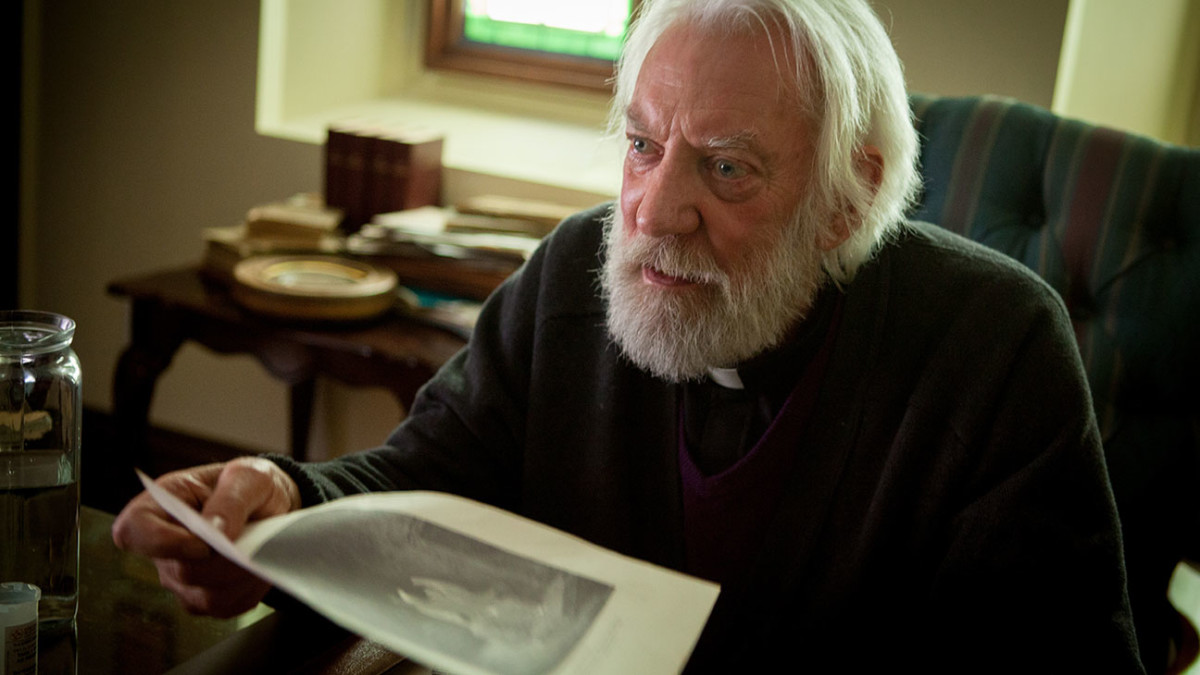
Hazel is painted a cold, pill-popping alcoholic toughened to the point of being allergic to flowers. Sarandon doesn’t seem the right fit, neither do the other big names of the cast, rather it is Gil Bellows whose performance stands out as Hazel’s combative partner. All other characters seem to fall flat or go to waste, including Donald Sutherland’s answer-providing priest who appears to explain the motive of the killer – the why – and considering we know the who from early on the slow pace seems unnecessary.

In the opening of the film when Sarandon stumbles upon the first victim, a family friend who is found with her throat cut to the point of near decapitation, it seems that that what is going to follow is a dark cat and mouse thriller – but we soon learn that this is an anomalous bit of action in a larger melodramatic film.

Shaken from their stupor it is hard to imagine how boring the town must have been before this advent, as even the pursuit of a murderer is somehow made dull and uninteresting.

20,000 Days on Earth (2014)

Written for RAF News September 2014

A conceptual music documentary that follows Nick Cave on the supposed 20,000th day of his life as he reflects on the past and ponders the meaning that he finds in performance.

20000daysonearth

Through a number of constructed set-pieces, the film frees itself from the duty of capturing authenticity and presents instead something more fitting of the Melbourne-born, now Brighton-based performer. And though Cave has many strings to his bow by way of his music, poetry and writing, he says that he can’t act. Perhaps it is this quality that gives the film a sense of realism without the need of shaky hand-held cameras.

Interviewed by a psychoanalyst on a set, under lights too bright, Cave remembers his father and reveals his biggest fears, namely: losing his memory. This set-up – a staged performance – is fitting of Cave, managing however to capture an honesty, which also explains the purpose of this documentary. The film seems to be an attempt for Cave to capture the past, to reflect on his purpose in performance, or in life perhaps, all captured in this dreamlike construct that appears at once self-aggrandising and self-aware – a humorous angle on the inevitable pretension that usually follows an artist talking about their art.

The fictitious day in which Cave journeys into the past and has happenstance meetings with old friends (Ray Winstone, Kylie Minogue among them) whilst driving his black Jaguar XJ, is fitting of the performativity that Cave talks about so passionately. At one point he reads from an old diary that contains rants about the weather of bleary old Brighton. He says of these writings that they are based on truth but ultimately a lie; a dramatisation. Following this, it seems that the film too is fantasy. One which is personal enough to reveal his thoughts on the transformative power of performance, but without ridding of its potency or tarnishing the image that he has come to embody.

A little more arty and knowingly contrived, the film playfully subverts the typical fly-on-the-wall music documentary, managing to create something more self-aware and yet somehow more sincere.

Watching the wires

Having adopted a deconstructionist approach to watching horror films so that they would no longer scare me, I had accidentally affected the way that I would watch all kinds of films by proxy. In trying to protect myself I had accidentally broken this readily available form of escapism. In one sense at least.


As time passed, I found myself growing fascinated with cinema and its inner workings – when it came to choosing subjects to study at college I was sure that I wanted to learn about human psychology to learn about persuasion and study marketing so that I could understand the influences of advertising. I studied Film as an additional course, but soon dropped another class so that I could take it full-time alongside extracurricular world cinema. Everything else became secondary. And though I couldn’t lose myself to a story, by believing it’s characters and being taken into the world created through sight and sound, I would be immersed in a different sense, amazed and engrossed by the processes of cinema. For this reason I feel like I am separated from a true experience. As though there is a barrier between me and the transporting fantasy on screen. I feel like a robot fascinated by love – interested in the mechanical elements, how the pupils dilate and the lips redden, able to understand the functionality but never able to feel it. At least not without being conscious of the fact.

wizard

It would take me a while to understand that my own personal fascination with how things worked, how film and television had their own methods of persuasion and manipulation, was not shared by others. I assumed that others would be taken by the methodology at work in things that they saw everyday. I had glimpsed behind the curtain and was excited to share my knowledge, unaware that most people were happier believing in the wizard. Excitedly I would dissect the reality shows that my mother enjoyed watching. ‘That stranger in the crowd is mic’d up. How did they get a camera inside the house before the crew turned up? There’s only one camera, the interviewer is nodding at no-one right now.’ I couldn’t understand that they were better off than me, where I knew there was just a bloke and a machine, they had magic. I had assumed that, like me, the more interesting part of a magic trick was in working out how it was done. This was the appeal for me, and so I would never truly appreciate the magic of cinema in the same way as others.

Scared Straight

I feel like I can’t watch horror films properly. I no longer find them scary – not as much as I used to anyway – and so feel like I’m missing out on a huge part of the experience. Like the audience at home watching cooking shows I can only comment on the things I admire aesthetically because I don’t really experience them – not how they were meant to be experienced anyway. This I blame on my parents.

evil-dead-1981

When I was 9 years old my parents split – that is to say they separated and not that they doubled-down in some form of mitosis, although I did have twice the amount of Christmases and birthdays from then on. I moved with my mother from an increasingly rough area in East London to a surprisingly rough area in Surrey. My mother continued to work in Islington and so I would go to a childminder’s before returning home. This was before I became a latchkey kid. Often I would spend nights in the house alone and would have to put myself to bed if mum was home late. Perhaps like many children my age I found the empty house unnerving at night – think: Macaulay Culkin screaming at the furnace. I would turn off the lights methodically, hurrying in turn as I imagined that a predator hiding in the dark would now make its move in the engulfing darkness. If I imagined it I was willing it into existence, so I thought.

Then one night I was lying in bed when I heard a noise from downstairs – and so began the battle between the frightened child and his rational mind. Now the area wasn’t that bad really, there wasn’t really the threat of a break-in unlike my house in East London which was robbed while we slept in the run up to Christmas – think: Guy Richie’s The Grinch. I knew that this was unlikely in our new house, or at least I wanted rid of the fear; so I got out of bed and went to explore the noise so that I could prove to myself that there was in fact nothing and I could go to sleep safe in the knowledge. This became a routine of sorts. If ever I heard a noise and was frightened, I would check it out in an attempt to condition myself out of fear.
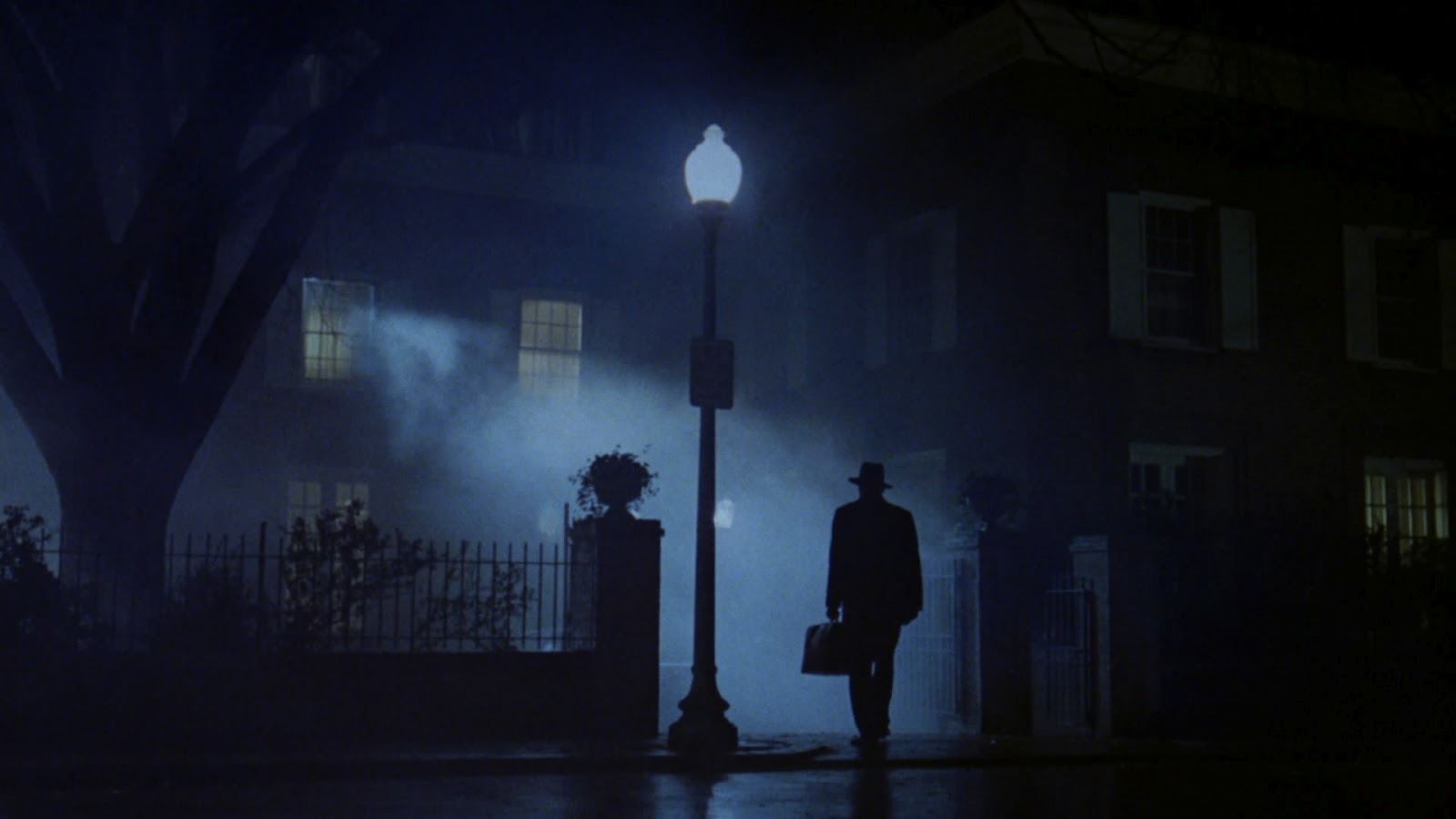
exorcist

Then I was faced with darkness. I had hurried to turn on the lights in case there was something lurking, biding its time. I knew this was my imagination but I frightened myself. So now to apply the conditioning: I would turn out the lights and walk slowly in the dark, if I felt scared I would make myself stand still until I wasn’t anymore. From then on, if I heard a noise in the night I would go to check it out and if I felt scared I would do so in the dark. This I realise may seem quite deranged but it made sense to me. I didn’t want the fear. The fear was worse than the threat.

During this time my father had moved to a few different places with different people until a few years later when he landed on the house and family that he has now. When they were moving into the house they found that the loft was still full of odd bits and pieces. I helped my dad to clear the loft, looking for anything interesting or salvageable and stumbled upon a trove of VHS tapes. Some vintage pornography, some Video Nasties, but mostly horror films in cardboard sleeves. I put all the videos into a black bin-liner and took them home. They sat on shelves opposite my bed for a while before I realised why I hadn’t watched them: I was scared. I was back to my pre-teen feeling of vulnerability that I thought I had shed.basket_caseHorror films scared me. I remember after my parents initial break-up, I was at my dad’s then flat with his then girlfriend where he was watching An American Werewolf in Paris. I must have looked frightened when I glimpsed it on the TV as he honed in on that expression of weakness. Playfully goading me he asked if I was scared – I lied – he told me to prove it and stand up-close to the screen whilst the wolf-transformation was happening – I did. I was proving myself to him, but lying to myself. Now I was looking at this collection of classic horror cinema and saw it as a challenge to the scared child that was still in me.
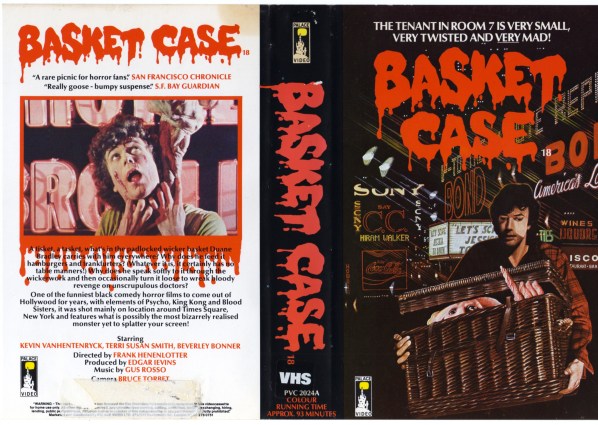
I began watching each of the films when I was alone in the house: The Exorcist, Basket Case, Cannibal Apocalypse, if ever I felt myself getting scared I would turn off the lights, The Texas Chainsaw Massacre, The Brood, still scared I would move closer to the screen watching The Evil DeadSociety and The Hills Have Eyes. I watched them with such focus, telling myself that they were just films, deconstructing them in order to understand how they were just films, that I managed to lose my fear which I kind of regret now, but it might just have sparked my interest in cinema. Swings and roundabouts I guess.

Blog at WordPress.com.

Up ↑