Spooks: The Greater Good (2015)

I hadn’t seen a single episode of popular English spy-drama Spooks before watching the new film – and it looks like it’ll stay that way. It had been described to me as less clean-cut and more toned down than its American counterparts but had started to grow more farfetched over its seven series stretch.
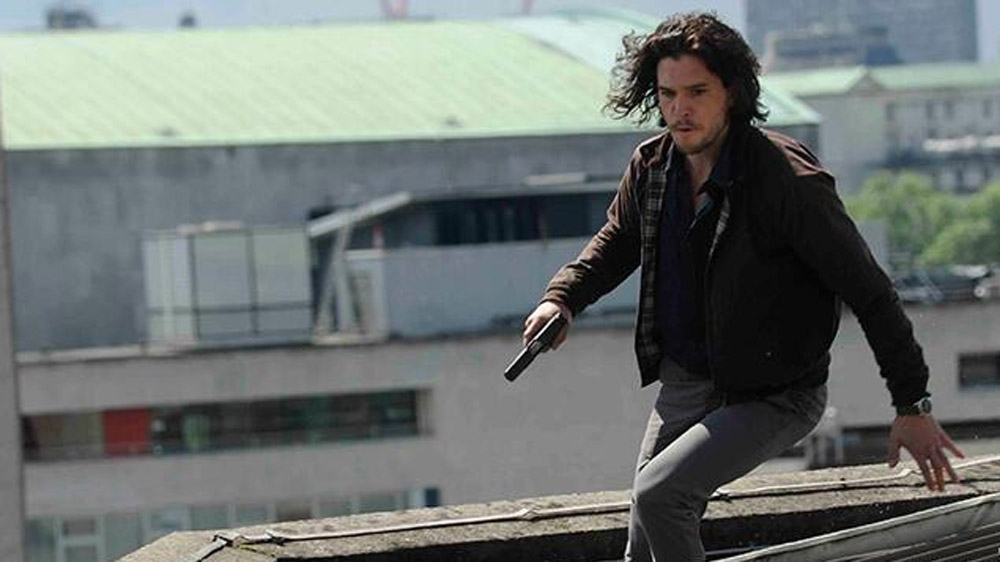
spooks

Spooks: The Greater Good opens to a London skyline behind a curtain of rain and queues of traffic stretching to the horizon – this seems realistic enough – but not the most desirable situation for the MI5 agents at the centre of this hold-up, guarding Adem Qasim (Elyes Gabel) a terrorist in transit. Something is wrong. Soon Qasim will make his escape and heads will roll.

Held responsible for this debacle, Spooks stalwart and Head of Counter Terrorism Harry Pearce (Peter Firth) is forced to resign and disappears soon after. With the organisation now under threat – they look to a fresh face to find Harry and the truth behind his disappearance.

Kit Harrington has traded Longclaw sword for government issued pistol as Holloway – the sharp, fast-thinking ex-MI5 agent who believes Harry is still alive. Speaking mostly in a gruff whisper, in need of a Strepsil, he’s most impressive when in action, and luckily for us he rarely stops for breath.

Spooks: The Greater Good certainly has its impressive set-pieces including Qasim’s breakout and a final shootout, both making the most of their locations. But in-between these bookended sequences there is barely anything other than hammy exposition-laden dialogue: suspicions running high, and characters just running. In these instances the locations become a distracting backdrop. When the film isn’t darting to Berlin and Moscow with sweeping aerials, it’s hopping about through postcard London skylines.
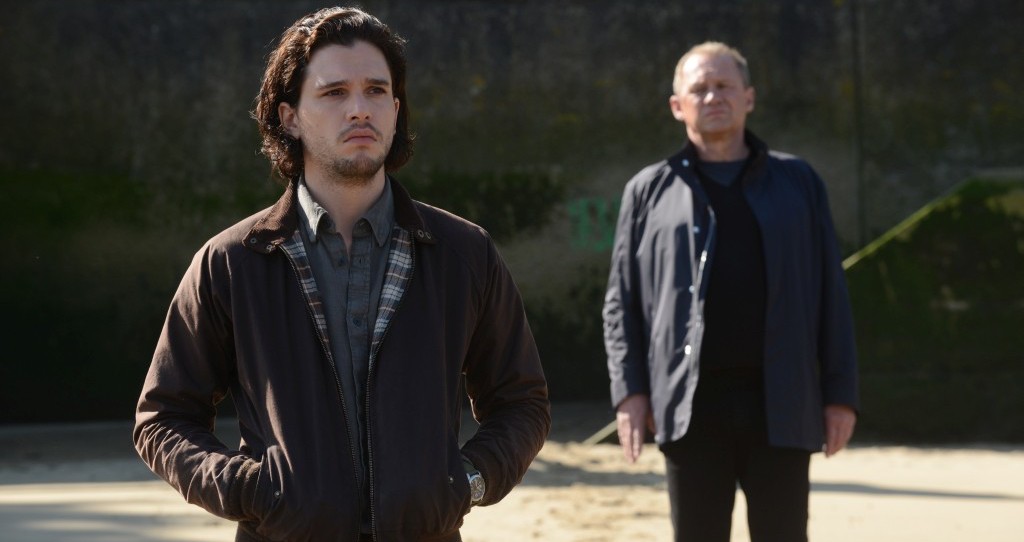
Spooks

Amidst all the toing and froing there’s everything you’d expect from a twisting espionage, filled with double crosses and conversations at the barrel of a gun. Surprisingly though, most of the film revolves around paranoia among the bods back home at ‘The Grid’ and as such the action scenes give way to TV melodrama. Qasim seems a more complex and rational villain, but he is talked about more than he is seen.

When the action sequences are in full swing the film is gripping but caught up in whom to trust, the film loses sight of the threat and the tension suffers for it.

Queen and Country (2015)

Written for RAF News Apr 2015

Queen and Country is John Boorman’s follow up to his Oscar nominated classic Hope and Glory – where the first film told a semi-autobiographic tale of his childhood during WW2 through the character Bill Rohan, this sentimental sequel picks up in his late teens when called for National Service in the Korean war.

q+c

Luckily for Boorman, and his film equivalent played by Callum Turner, his duties consist of teaching recruits to type before they are shipped out to the frontline. The biggest threat to Bill is his pedantic Sgt. Major Bradley (David Thewlis) who has the manual of military offences committed to memory. Bill catches some of his righteous fury when accused of seducing a soldier from the course of his duty after speaking out against the war, and so too does his close pal Percy after meddling with the RSM’s precious clock.

By focussing on the pair’s frivolousness antics against the backdrop of a hellish war, Boorman once again explores his own personal, perhaps wilfully naïve, experience – continuing on from Hope and Glory with the same light-hearted whimsy. The film is certainly a comedy with a traditional more campy approach but this later effort edges closer to romance. Where he once sought companionship from local kids rummaging around bomb sites for trophies of shrapnel, Bill now longs for a girl known only to him as Ophelia.

Turner is pleasantly understated as Bill, though this may just be in contrast to Caleb Landry Jones who gives a strange and strained performance as his sidekick, pursing his lips and chewing scenery when given half the chance. Aside from this pair, it is the supporting cast who steal the film – Pat Shortt’s professional skiver and David Thewlis’ uptight Sgt Major carry the laughs, whilst Vanessa Kirby adds a dose of dynamism as Bill’s sister back home.

A Most Violent Year (2014)

A Most Violent Year moves with a steady and deliberate pace, captivating with an intensity that feels like it could turn at any moment – much like the self-made businessman at the centre of the story.

AMV

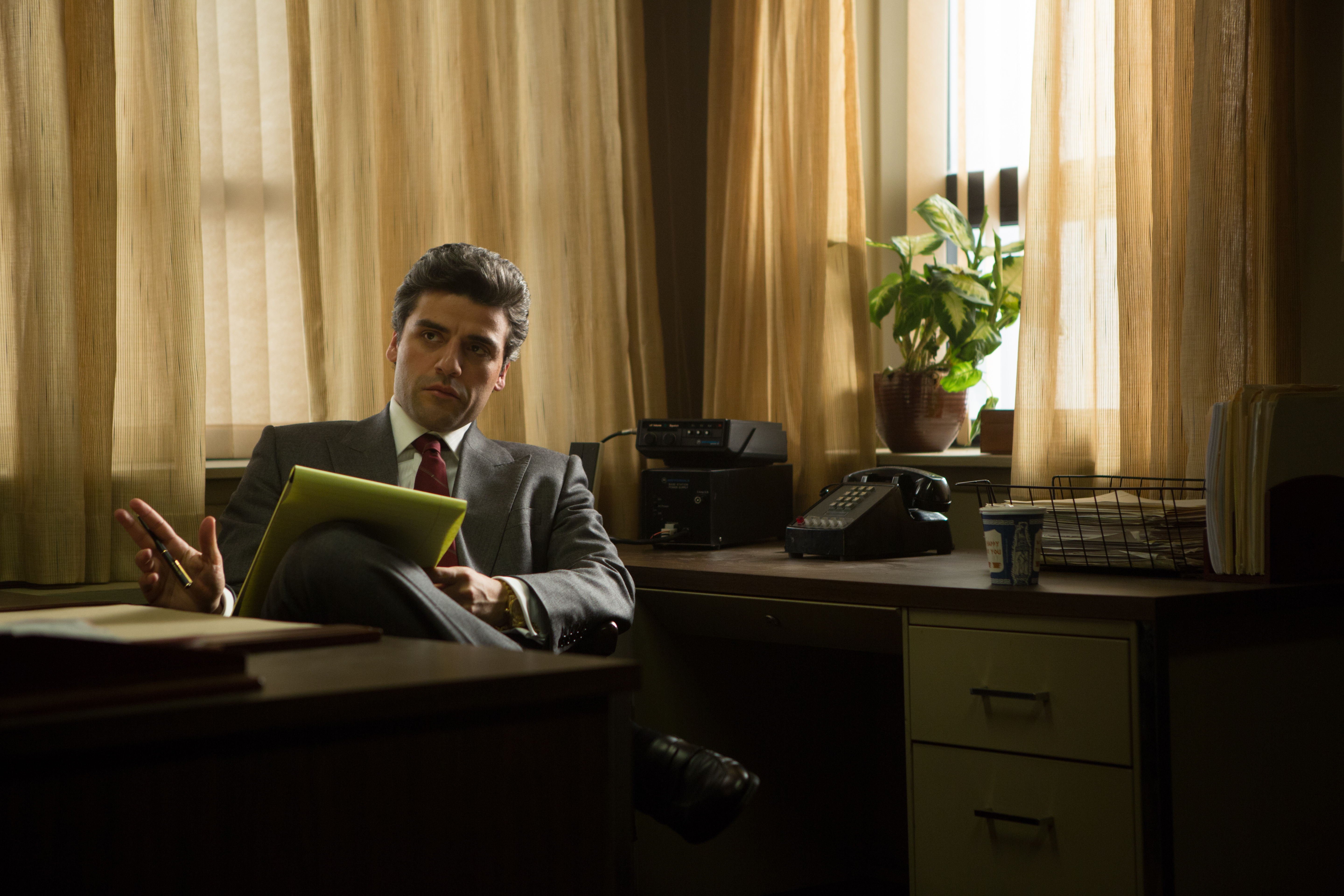
Abel Morales is an oil man. A Columbian immigrant who has striven to succeed legitimately and carve out a piece of the American Dream for him and his family. The first things we see in the film are Abel (Oscar Isaac) his lawyer (Albert Brooks) and one of his trucks emblazoned with Standard Heating Oil – the same name as Isaac’s character in Drive in which he starred alongside Brooks. Where Drive had the garish stylism of the 80s, A Most Violent Year – set in 1981 – couldn’t be more different: it mutes its colours and completely tones down the style to create a dulled wintry New York more in line with Sidney Lumet.

A more mature and meditative film that carries the measured approach of its cool-headed protagonist. Where Gosling’s Driver was liable to crash the film into sudden chaos, Abel exercises a control that keeps the film levelled, intent on maintaining his companies growth and keeping his hands clean. This is becoming something of struggle however, considering that his growing success is making him the target of multiple hijackings, and subject of criminal investigations simultaneously.

Another film promising blood – delivering oil

The films title, though misleading in terms of genre, references the peak crime rates of New York in 1981, the climate in which Abel’s drivers are hunted down. Abel, a man of morals, knows that he must resist the temptation to retaliate, especially whilst being monitored so closely by the assistant DA (David Oyelowo) and whilst he tries to secure a sizeable loan for a property in which he has invested everything. This doesn’t actually seem to be the prime motivator for Abel though, a first-generation immigrant who is defined more by his principles: a resilient man tested only by his wife, a steely Brooklyn mob-daughter who threatens constantly to take things into her own hands – her emasculating shadow captured perfectly during a roadside incident with an injured deer.

In the pursuit of power there comes the exchange of exposure and vulnerability, which is communicated through the lighting in each scene. Most deals take place inside under heavy-set shadows, or with curtains drawn, or silhouetted against the sun. Only when someone is exposed are they lit from the front – it’s almost jarring the first time this happens as it feels so out of place in the film. It seems the pacing and filming style are intrinsically tied to themes within the film and work subtly enhance the performances, which are impressive in their own right.

A Most Violent Year is a boldly confident film – and it deserves to be.

Selma (2014)

Written for RAF News Jan 2015

In the wake of Martin Luther King Jr.’s  historic ‘I Have a Dream’ speech, and after the supposed break up of segregation in the States, Selma picks up in the south where things don’t seem to have changed much at all – where four girls have been murdered by white supremacists and where black citizens are still prevented from registering to vote.

selma

When Dr. King (David Oyelowo) hears this news, he decides to use his platform to bring attention to this continued injustice by arranging a march from Selma to Montgomery Alabama.

Although Dr. King is introduced accepting the Nobel Peace Prize, he is not shown to be an outright hero but a passionate and charismatic preacher who knows how to use a stage and move a crowd. No film had until now focussed on Dr. King and so it comes as a pleasant surprise that director Ava DuVernay avoids the pitfall of deifying this cultural icon and instead shows him as a man – a complex figure complete with all his faults and foibles.

Oyelewo’s King presents the contrast of the man on and off stage: speaking with a measured poetic rhythm that erupts into familiar passionate cries when in front of a crowd, but thoughtful – at times doubtful and doubting even – behind closed doors.

In showing this side to Dr. King, Selma is able to shift focus to the issues at the core of the film and observe the people that marched together on that momentous day, exploring their individual stories and struggles. In a sense Selma looks at the human side of a legend, showing Dr. King to be an ordinary person, and the extraordinary side of regular people as they came together to stand up against oppression.

Locke (2013)

Ivan Locke (Tom Hardy) must juggle the collapse of his marriage, pacify the pleas of the woman about to give birth to his child, and oversee the preparation of a job that he has just left behind in order to be at the hospital – all of this he must do on the drive from Birmingham to London constrained to the phone in his car.

LOCKE

Ivan is a level-headed pragmatist whose efficiency is the evident force behind his success as a construction foreman. Though now, due to a one night stand with a woman he felt sorry for, he decides to be present for the birth, which means abandoning one of Europe’s biggest ever concrete pours for the base of a skyscraper. All we see of Ivan is how he interacts with others over the phone; how he deals with mounting levels of stress from all directions. Somehow – under the weight of overlapping crises – he maintains a rational distance that allows him to remain in control, even as events tear away from him and spiral.

Ivan shares his name with the Enlightenment age English philosopher John Locke, who supported the theory of the tabula rasa, or: the blank slate. This theory proposes that humans do not have inherent or innate qualities, that they are instead shaped by their own experience. In the case of nature vs. nurture the blank slate supports the latter. This is the defining feature of, and prime motivation for, Ivan. Between phone calls he is caught arguing with the spirit of his late father, raging at empty backseat through the rear-view mirror, as though he is being beckoned from beyond the grave to become a failure and a bad father. Ivan uses this fury as fuel to break the cycle of nature – to prove that he can decide his own fate and straighten the family name. Not only does he decide to be present for the birth, but he tasks himself with overseeing an enormous job that he will likely be fired from anyway. This does not matter, Ivan has set a precedent of loyalty that transcends the divide of business and personal, significantly painted with the metaphor of laying the foundation of a building. But as he states himself of the skyscraper, if cracks appear at the base, support is compromised and it becomes a threat.

Like the eponymous character, we too are locked in this situation; trapped in this single location for the journey. However, the film seems to not only be aware of this, but weary and apologetic, as it aims to keep things visually interesting by constantly cutting to external shots and various distracting angles. Shooting the entire film from start to finish in one take (or 37 minutes due to the capacity of the memory cards) and repeated two or three times a night for 6 days, the performance naturally has tension built into it’s construct and thus holds a pressure of it’s own. When permits to film on the M1 were revoked at the last minute, it is as though life was imitating art and echoing Ivan’s struggle to arrange road closures. Not only that, but the cold that Locke suffers is actually Hardy’s; the frustration that bursts out of Locke in reaction to the call waiting alert is Hardy’s too – actually reacting to the petrol gauge as it interrupted the drama and altered later in post-production. The tension of the film is palpable as it is, to some degree, real. buried Buried (2010), the single-location thriller released a few years prior, had a similar concept and incorporated a similar style, with sole actor Ryan Reynolds buried alive in a coffin experiencing a more life-threatening stress whilst other characters appear as voices in phonecalls. Focussed on a more extraordinary situation, this Hollywood film is suitably made into a spectacle through it’s set design which allowed this minimal space to be transformed. Locke, which is so gripping for its realism and its nuanced performance, does not need this escape or stylism. There is enough movement in frame to keep the your attention and Hardy offers a captivating performance in the subtlety of his acting: each micro-expression magnified by the intensity and intimacy of the camera. When Ivan first smiles it comes as a relief, it feels sincere and hard-earned and so we experience this same satisfaction. It seems that this could have all been heightened if the direction hadn’t taken attention elsewhere – it was as though the film’s strength was being treated as it’s weakness, and so it missed out on the payoff of its bold simplicity if it had simply let the action unfurl in longer, uncut takes. That being said, the tension is inescapable still, and the film is undoubtedly ambitious as it is. An impressive film that shows the capacity of film to do so much with so little.. and Tom Hardy.

Create a free website or blog at WordPress.com.

Up ↑