Ant-Man (2015)

Marvel films are lost on me.

During fight scenes or action sequences I tend to glaze over and lose interest. I couldn’t watch the first Avengers film because after 10 minutes I didn’t care about anyone or anything on screen.

Other than Tony Stark’s Robert Downey Jr. delivery I don’t get the humour. Thor I found cringeworthy, and the rest that I saw took themselves way too seriously. I can’t buy into it. I can’t get into that style of acting – that hammy, cheesy croque monsieur of self importance that can inject gravitas into a glance.

That was until Guardians of the Galaxy. Taking an obscure Marvel comic with an absurd premise, attaching a director who had shown his comedic sensibilities and awareness of the superhero tropes in The Specials, and creating something much more subversive. A Marvel film that was self-aware, self-deprecating and funny.

This is what lead me to see Ant-Man. I knew nothing other than Edgar Wright and Joe Cornish had been involved and that it was about an ant-sized superhero. It sounded absurd, surreal and like it would be impossible for it to take itself too seriously. Alas, nothing is impossible in superhero movies.

Whilst the film tried for comedy it felt like it was the ideas, the concepts themselves, that were funny – and so I never really laughed out loud (a couple of exceptions in Michael Pina). The first time Rudd shrinks down to size he is thrown through a series of obvious trials like something out of the Magic Schoolbus or Micro Machines – a bath-tub! a hoover!

I didn’t believe Paul Rudd for a minute. Not as a hacker nor a nimble-ninja cat-burglar. Not a superhero or even a father. Perhaps I’m looking in the wrong place for believability but I was never involved in the film. What I found really jarring was the whiplash from utter silliness to sober melodrama which I think is symptomatic of this type of film.

Where Guardians parodied the Marvel format, abiding the rules but taking the piss at the same time, Ant-Man just slots right back into it with endless reams of exposition, the obligatory montage sequence, and a heavy dose of melodrama. It felt painted by numbers and I didn’t care about what picture was being created. It’s funny that the stakes of the film are so much lower than the Avengers films (not funny ha-ha) but to me it just captured the problem that I have with Marvel films – I don’t care about anyone in this world. It feels silly. The fight scene between two micro-sized men on a Thomas the Tank Engine track was funny because it acknowledged the format, how Marvel are reliant on scale as a spectacle, on illusory effects.

I know that I am in the minority for not accepting this film as a bit of fun, but it just wasn’t fun for me. It was boring and lifeless. The concept of going sub-atomic was great and so too were the effects used to capture the microscopic landscapes, but it just wasn’t strange enough. It was just another Marvel film. And Marvel films are lost on me. I’m sorry.

A Girl Walks Home Alone at Night (2015)

Bad City, a comic book mesh of Iran and the US – like the film’s writer/director Ana Lily Amirpour – where pimps, whores and drug addicts fill the street at night, watched over by a lone girl in the shadows: a vampire in a veil.

girl

The genre is given new cultural significance in this middle-eastern setting despite being shot in the Californian desert. The chador becomes a cape. The meek silence of an impassive woman becomes more an ominous threat. The Girl isn’t lead around by men, she stalks them.

The vampire becomes an icon of female empowerment and violent revenge as the seemingly vulnerable girl walking home alone at night is actually the predator here. Yet still, after punishing a lowlife pimp who closely resembles Ninja from Die Antwoord, this moral avenger knows she has done wrong. She is bad. Sinful even.

Shot in black and white, spoken in Farsi, and with a sleek soundtrack comprised of indie, punk, traditional Iranian music and tinges of Ennio Morricone, the film is aware of how cool it is, or at least how cool it wants to be – take for instance our vampire’s penchant for skateboarding, or our James Dean modelled hero Arash.

The confidence of the film, reinforced by often beautiful composition, does allow certain scenes to unfold slowly and with greater impact. One truly beautiful scene sees Arash in The Girl’s room, dressed up as Dracula, very gradually approaching her back. A spinning disco-ball throws fractured light around the room, adorned with slightly off iconic music posters (think: Ghana’s bootleg movie posters), as the distance between them is closed so very slowly, lasting almost an entire song.

Unfortunately these slower, more deliberate scenes are dropped in favour of typical genre conventions, steering into something much more predictable with less flair and originality. There isn’t much to the story itself, and some crucial moments and character decision’s really don’t add up.

Overall the film does feel a little style over substance, but it sure is a sleek style worth paying attention to. At times.

Ex Machina; or, The Modern Frankenstein

While most reviews of Ex Machina (2015) reference Frankenstein, none that I read unpacked the idea fully. Here I want to focus on the character of Nathan Bateman, played by Oscar Isaac, and how he compares to the archetype of the mad scientist.

Ex-Mach

Just as Dr. Victor Frankenstein, Nathan isolates himself from society and hides away in his research facility. He has a sole companion and servant – though trade hunchback gravedigger Fritz for android concubine Kyoko. And he dedicates himself fully to his work, the work of gods: creating life.

Victor Frankenstein’s first words upon reanimating his monster: ‘Oh God! Now I know what it feels like to be God.’ It makes sense then that his creation is constantly compared to Adam, the first man. Nathan takes the baton from his predecessor and endows his own artificial intelligence with sexuality, creating Ava (an Anglicised version of Eve) – the first woman.

Nathan playfully alludes to his godlike status when misquoting a remark made by Caleb, employee and human component of the Turing test, “I’ll never forget it, you turned to me and said ‘You’re not a man you’re a god.'” Continue reading “Ex Machina; or, The Modern Frankenstein”

The Babadook (2014)

The Babadook is a bold original horror that scares rather than startles – every moment carrying the unease of a dark underlying reality.

babadook

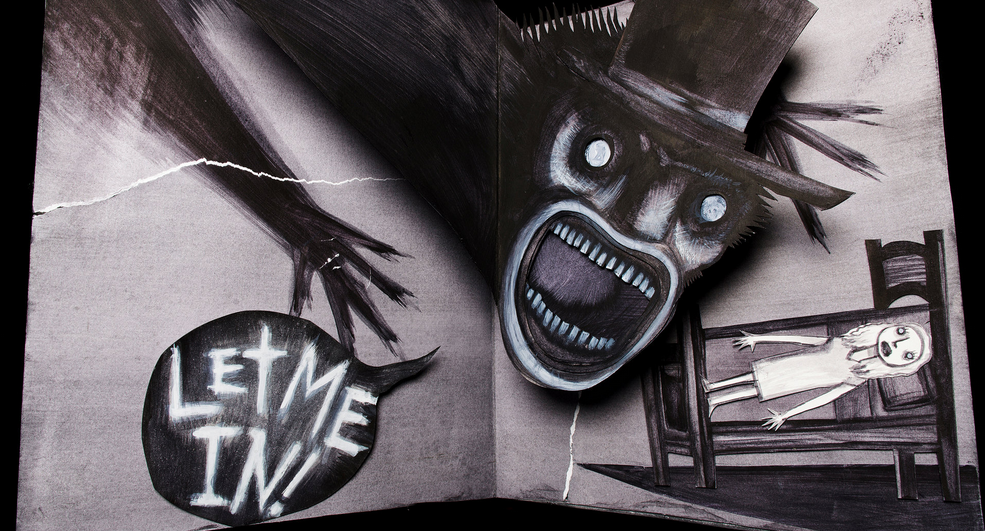
Amelia is struggling to cope with her manic son Sam on the run up to his seventh birthday – a date that also marks the death of his father. Sam’s disruptive behaviour swings wildly out of hand when he discovers a pop-up book that warns of an unstoppable monster in a ‘funny disguise’: Mister Babadook.

The book, a grim (with one ‘m’) fairy-tale, is beautifully crafted and a great centrepiece to the film. It comes to life not only through its eponymous character but in the production design, with hidden faces in the décor of each scene. The saturated blue, black and grey against white create a similar palette to the book and at times embodies The Cabinet of Dr Caligari – but Mister Babdook is no somnambulist, rather an expressionist inversion of the Spirit of Jazz, dressed in a top-hap hat and cloak.

This character is actually not so frightening outside of the book. Once he takes physical form and steps out of the shadows, he is just another bogeyman – drained of his symbolic potency. This is surprising though considering the chilling monster of the short on which this film is based. Even so, it is what Mister Babadook stands for that is so deeply disturbing.

Whilst the big studios remake classic horrors (Don’t Look Now! First Wicker Man now this…), and the new semi-independent horrors insist on reminding us how scary children are, especially when they suddenly appear with an orchestral crash,The Babadook flips the idea on its head. It explores much darker territory. It explores a very real horror but through this phantasmal figure.

The film is far from subtle. It lays out the direction of the story early on through the storybook, unpacking all of the symbolism and explaining away the subtext through exposition and sometimes unnecessary scenes. All of this it does in the first act and yet the idea is so haunting that it keeps you in locked suspense. It remains scary even when you know what’s coming – because you know what’s coming. This feeling doesn’t quite survive a second viewing but it remains impressive as an original.

The Babadook gets under the skin and unsettles – truly a scary film with a great concept.

Moomins on the Riviera (2015)

Written for RAF News May 2015

Tove Jansson’s classic comic strip has found its way to the big screen after 60 years, with the Moomins setting sail for the south of France in search of adventure and a taste of the high-life.

MoominsOnTheRiviera

Snorkmaiden, taken by the allure of champagne on the beach, leads Moomin (a cingeworthy Russel Tovey), and his family, as they set out in a humble sail boat across stormy seas to find themselves like fish out of water among the glitz and glamour of the Riviera.

The traditional hand-drawn animation gives the film a beautiful composition that can at times blossom into glorious surrealism – roughly sketched storm clouds shed long streams of raindrops over a golden sea as the well-meaning Moomins find themselves in trouble once again.

Where most films aimed at children these days have an edge to them, layered with jokes for the parents or breaking from the story with a wink-nudge, Moomins on the Riviera carries charm in its sincerity (although there is one brilliantly absurd moment when a character falls in love and has to get his cousin to take his place in the story whilst he gets married.) Where 2D cartoons like SpongeBob SquarePants and puppets like the Thunderbirds have been converted into CGI its impressive how Moomins holds onto its very essence in both values and visual style.

Throughout their ordeal of being mistaken for eccentric royalty and running up bills that they can’t pay, the Moomin family maintain their naïve sense of wonder and innocence. Though they can be swallowed by insecurities and anxiety, they are for the most part delightfully free of self-awareness. This works in complete contrast to the snooty jet-sets of the south of France where the sharp faced locals are interested only in status and celebrity. “We simply don’t fit in here” comments MoominMama, noticing the gap between their way of life and that of local star Audrey Glamor.

Moomins on the Riviera meanders for the most part but it is certainly a heart-felt children’s film that, like the family leading the adventure, isn’t trying to be something it isn’t and embraces its character.

Blog at WordPress.com.

Up ↑