Reality is folded in on itself in this playfully mind-bending Filipino drama turned pulp action romp.
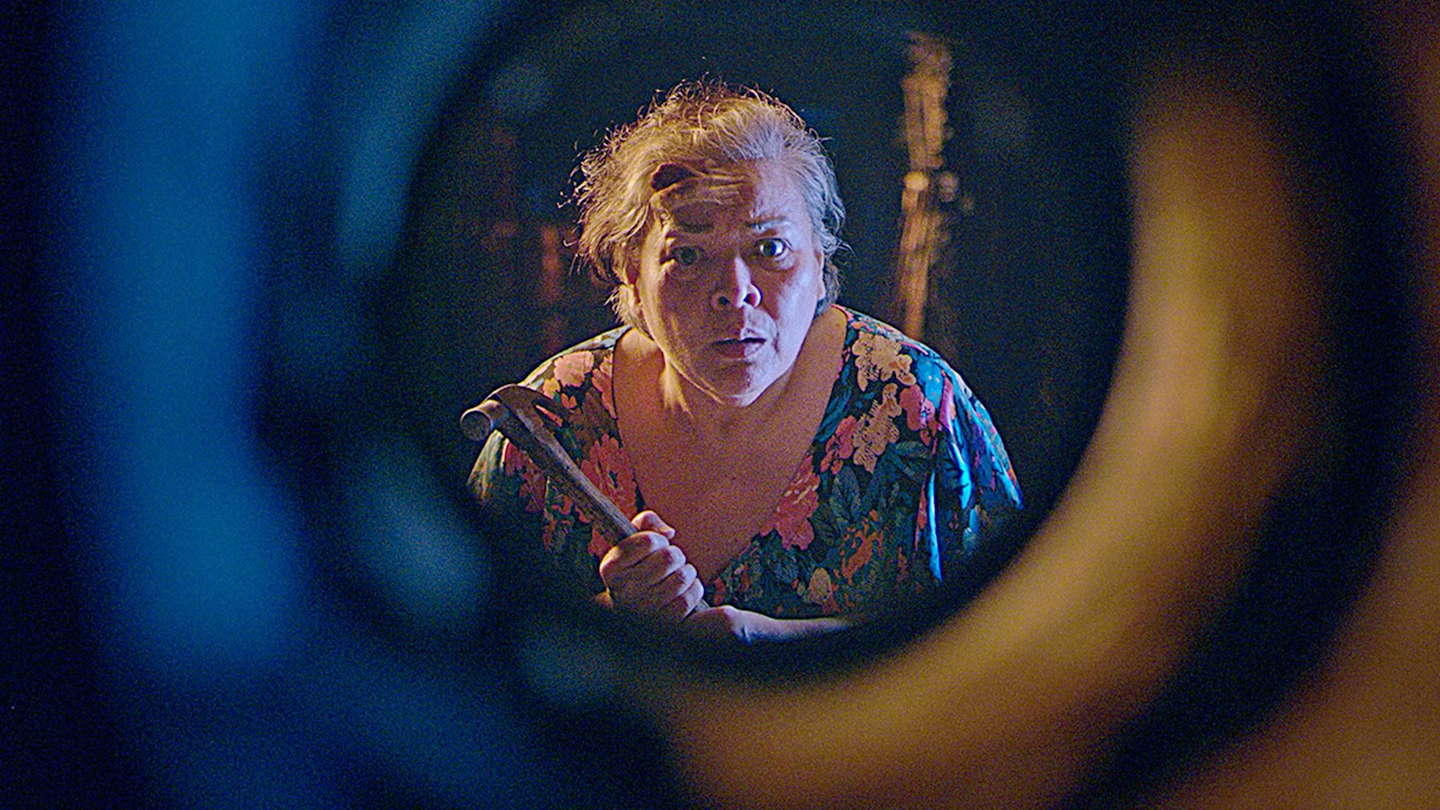
Leonor (Sheila Francisco), an ageing screenwriter with a taste for violent movies, is suddenly thrust into one of her own films when she is hit on the head by a television that puts her into a coma, leaving her in the thick of an unfinished vengeance story she had just dug up for a screenwriting competition.
Now a fly on the wall, she writes the story as she goes, observing action hero Ronwaldo (Rocky Salumbides) as he aims to avenge his brother (Raion Sandoval) and save the girl (Rea Molina) from a gang of drug-dealing street-toughs. Meanwhile, Leonor’s son Rudy (Bong Cabrera) with whom she is living back in the real world, tries to comfort his mother and pay the bills, by shopping around her unfinished script.
And so the film jumps from the domestic struggles of Leonor’s family to stunt-work and high body count shootouts. What makes the film within the film so watchable is the B-movie aesthetic straight out of 70s Filipino cinema: funky bass score, and sound effect heavy fight scenes that have instant replays.
Leonor Will Never Die is fun and inventive, able to dip into the action whenever it pleases. As novel as it sets out, it continues to get more complex as it progresses, adding layers and blurring lines of what is in the reality of the story – at one point Leonor’s family cannot find her in the hospital, only to find her in the action movie on the television.
Building to the classic genre showdown, it stays fun but gets a little greedy, piling on the self-awareness and deconstruction until it has nowhere else to go.
Revered photographer and artist Nan Goldin reflects on the events that shaped her craft and character, all the while fighting one of the most powerful families in America, in this challenging and poignant documentary.
Goldin is funny and unflinching, able to revisit trauma by tackling it head-on. Goldin delves into the loss of her sister at a young age, the ravaging effect of Aids on the queer subculture she was a part of in 70s New York, the political indifference that they faced as a result, and their reaction: to band together and speak truth to power.
The group that Goldin fell into in this social scene was comprised of artists, activists and outcasts. People who seemed to possess a knack for self-expression and a sense of humour. It was here that her artistic sensibilities were nurtured, turning the camera on a life largely unseen, laid bare and beautiful. We see part of the slideshows that she would show to crowds, the ever-changing series ‘The Ballad of Sexual Dependency’. In the documentary, we learn of her experiences with men and women, of domestic abuse, and sex work.
The scar that runs along the film however is Goldin’s own history with pain medication, namely OxyContin. Having battled addiction from this over-the-counter drug, and witnessed its destructive power, Goldin formed the group P.A.I.N. (Prescription Addiction Intervention Now) in 2017 with a group of likeminded people. Using her position in the art world to target the Sackler’s – the family and pharmaceutical empire often blamed for the opioid crisis in the United States – who have historically had their names in art galleries around the world. Here we see P.A.I.N as they infiltrate museums with elaborate signs and props, an artistic installation of sorts, that carries an important message, honouring the hundreds of thousands who have died in this epidemic.
Many of these reputable art houses would love to have the work of Goldin, but they get a little more than they bargained for.
The line between the convict on the stand and the witness in the box is blurred in this contemplative, courtroom drama.
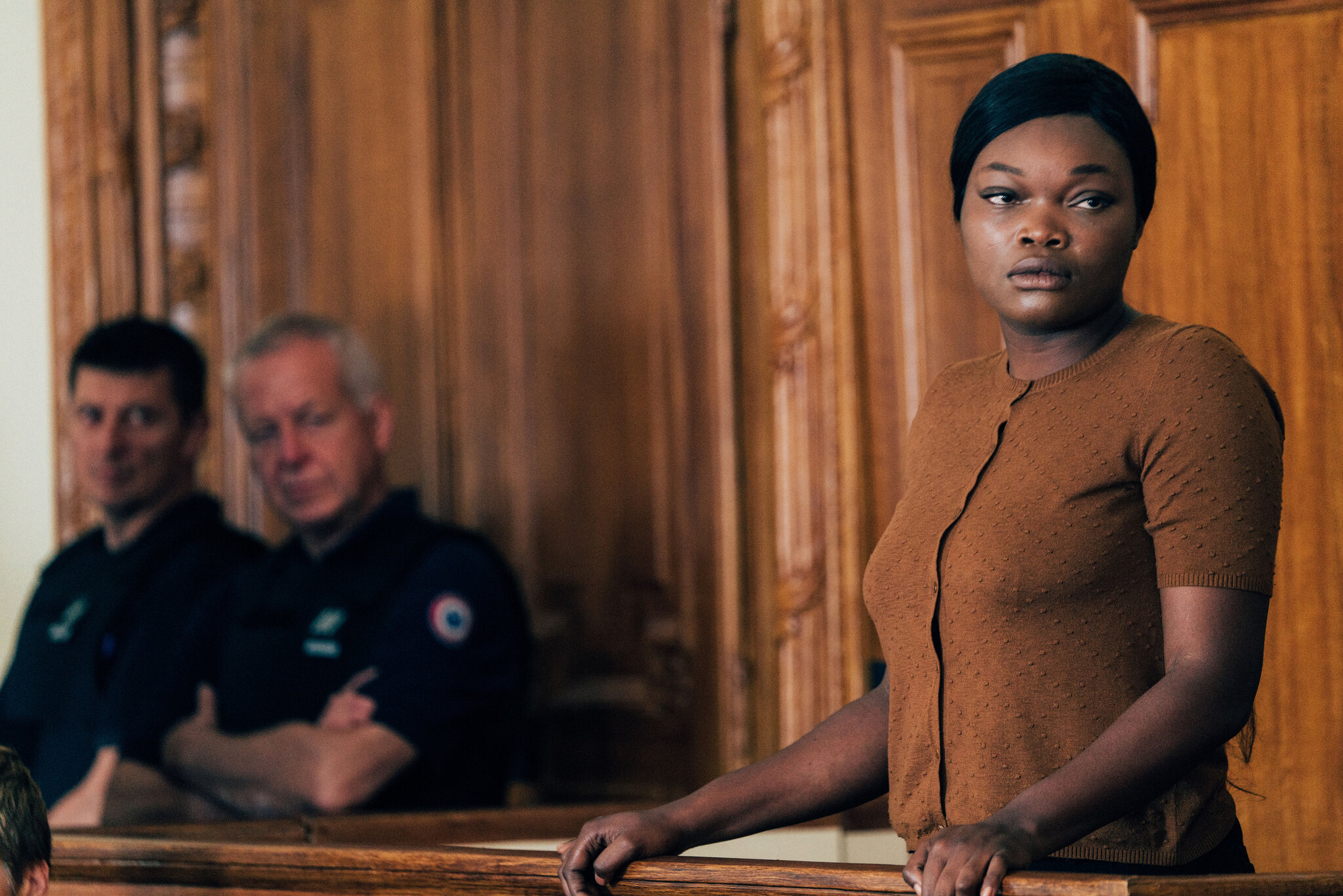
Rama (Kayije Kagame) a celebrated author, is in the process of writing a book when she is drawn in to the local trial of Laurence Coly (Guslagie Malanda): a women charged with the murder of her 15 month-old daughter. Like Cosy, Rama is French and of Senegalese decent, and seems ambivalent about her pregnancy.
Based on a real trial, that director Alice Diop attended, we see the complexity of characters presented through their testimonies, but also in reaction to the testimonies of others. The film is very deliberate in its voyeurism. Long takes focussed on a single person allow you as the audience to become the jury. Avoiding theatricality, it is the nuance, the micro-actions and reactions, that make this film resonate so deeply.
Cosy (played phenomenally by Malanda), is introduced as someone who has committed the most heinous crime of infanticide. Having left her child on a beach as the tide was coming in, she confesses that she is responsible, and yet bafflingly pleads ‘not guilty’. This is just the beginning of this difficult and contradictory series of revelations. As we listen to Cosy speak in defence of herself, she is eloquent, a gifted student of philosophy she has a way with language, and so is able to express a certain messiness that is ultimately human.
This spell is sometimes broken by the pointed questions of attorneys, like for instance after the testimony of the murdered child’s father (Xavier Maly), a more senior man whose sincerity is deconstructed swiftly by some perfectly aimed accusations.
As well as unpicking these personalities, the film throws into question larger ideas and assumptions. The whole legal system is seen as a product of its culture when the defendant claims that ‘sorcery’ was involved, creating a debate around the validity of African mysticism in a Western court of law.
Saint Omer is slow paced and purposeful; it does not pander but simply gives you room to observe. It is simple and confident filmmaking that will appeal to active watchers who like have their views challenged.
This past weekend I began the day with a booze-fuelled brunch, followed by afternoon cocktails and an evening BYO BBQ. The hangover came late on Sunday but the real pain lay in wait. I spent three days in agony before finally seeing a doctor to find out that I’d fucked the acidity levels of my stomach. This being my first visit in 17 years, Dr. Chang gives me some ulcer medication for what is more like acid reflux.
I pop a pill from my prescription and head straight to a screening of Peter Strickland’s latest: Flux Gourmet. Within the opening moments, the protagonist is diagnosed with something akin to acid reflux. He describes the same symptoms of trapped wind that I have been enduring, that I continue to endure, the pain as well as its social stigma. The audience laugh; I laugh. Bums and farts are undeniably funny, children know this instinctively. And still we chinstrokers of the dark guffaw, not at the sound of a particularly melodic or prolonged parp, but of a man describing the torture that he experiences abdominally in trying to avoid slipping one out.
Perhaps itslaughter in the absence of farts, laughter at the wondrous farts of our collective imagination. Or maybe it’s because we empathise and understand, we know the base level of humour, and therefore the inevitable shame. I for one know the fucking pain, I feel it pulsing inside me between laughs, a knot of tension that daren’t be untied in such a confined, public space. Still, on with the show.
Thoughts:
Flux Gourmet is delightful.
Focussed on a Sonic Catering Institute and the culinary band they have in residence, it plays in this world whilst wringing out the tropes of bands whose members are filled with sexual tension and rivalry, pompous performance theatre and classic horror cinema – and yet never feels insincere.
Not so much tongue in cheek, but twitch at the lips, glint in the eye. At points it seems deadly serious, others extremely playful and yet the two are intrinsically bound.
Serious ideas, ailments, psychology and human drama are explored, purposefully encased in art that announces ahead of time that it is in on the joke, and you’re laughing at the wrong part. And yet that glint in the eye.
It is so stylistically imagined, so wonderfully composed and deliberate that it feels perfectly balanced. Kaleidoscopic Giallo nightmares are cemented in assurance by the score, pricked with occasional nonsense that allow you humorous relief, that sly wink that lets you in – it is carefully designed. This is no accident, which means there is masterful subtlety at work.
Unlike contemporary Yorgos Lanthimos, the absurdity here is just so, allowing you to forget the silliness of the world before being reminded with a bang, by the disgruntled culinary band The Mangrove Snacks as they throw a terrapin through the window. It flirts with the obscene and taboo, but once again puts it in a frame and strokes its chin before nudging you with its elbow, snickering under its breath.
Our narrator, the one diagnosed with a disturbance in his gut, is a portly Greek man who speaks in a bassy, confessional manner. Combined with the endless scarlet backdrops and food arrangements, it feels at times like Almodovar. Rather than comment on the events playing out before us, he talks of the torture of his own physical ailments – his endless discomfort revealed to the audience in confidence, but due to the nature of his complaint, and the flatulence that it entails, it is made comical. And yet this pain is real, and its depiction authentic. A Buñuellian raised eyebrow, a judgement we the audience must question ourselves.
Flux Gourmet combines many of the themes present in Stricklands former films, the middle segment of a Venn Diagram that contains horror, sex, food and death. It feels most like his previous film, especially in the way that it satirises the experience of shopping – with In Fabric dissecting clothes shopping as a kind of capitalist ritual, whereas this puts food shopping on a stage, drawing attention to minor shared experiences like some form of Lynchian observational comedy.
A documentary on a gigantic scale that targets the industrial machine of China, watching the flow of consumer goods and loss of individualism all through simple yet stunning observation.
Ascension opens to a sea of people in the street, jobseekers all being herded towards potential employers, the conditions announced through megaphones: 18-38, no tattoos, no hair-dye. One advertises a seated job, another offers standing, but both pay just over £1.50 an hour. Jessica Kingdon’s documentary sets out to show the industry of China by looking at the products being created, the people creating them, and the consumers who purchase them. There is no need for narration, the images speak volumes.
Inside the factories, we witness the mass-production of everyday items such as water bottles, aerosol nozzles and ‘Make America Great Again’ baseball caps. Like TV show How It’s Made, there is a great satisfaction in watching the rhythm of the machinery producing a never-ending stream of objects: the hypnotic flow and tessellation, but the remarkable thing is how the people working in these factories become extensions of the devices they operate, with their own endlessly repeating movements. The last sign of humanness almost lost in their shared vacant expressions.
At times the documentary appears as science-fiction, watching the absurd mundanity of people assembling sex-dolls from parts, their cartoonishly proportioned bodies laid-out, mangled and decapitated, as they are put together and painted to order. It is eye-opening, shocking but also bizarrely funny.
We also witness citizens being prepared for the service industry: young men learn how to become human shields for the security business, whilst others learn complete obedience in order to be a butler of Downton Abbey merit. Full conference rooms are lectured on how to succeed in the ‘fan economy era’ and amass a following by monetising their knowledge; whilst others are taught the correct way to hug and how many teeth should show when smiling (it’s the top 8 in case you were wondering.)
The sheer size and scale of this film creates a dwarfing spectacle that is both staggering and entrancing – it certainly makes for strange and wondrous entertainment.




 samcooney