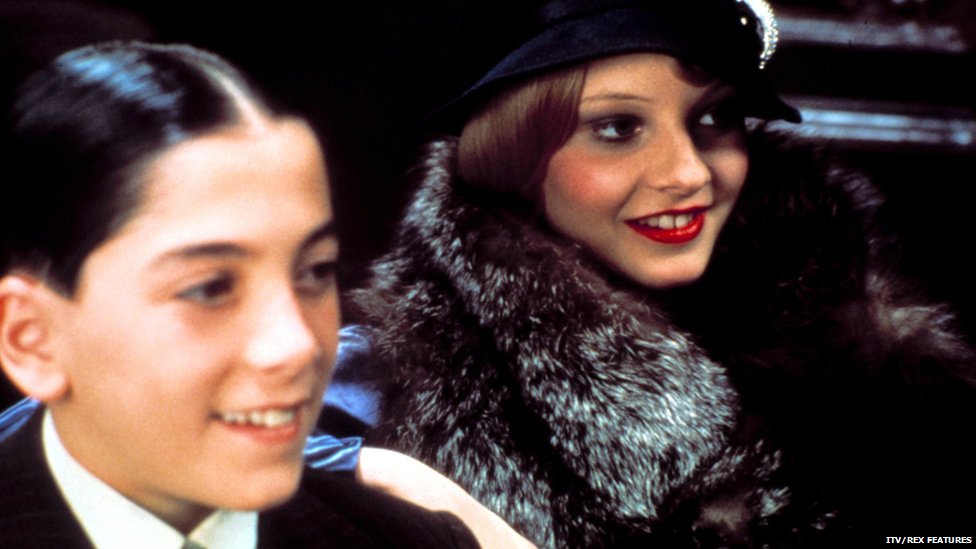
Bugsy Malone is a children’s classic that tells the story of two rival gangs in prohibition era Chicago where a new weapon has arrived on the scene.. a child friendly Tommy gun.
Shot in 70s London and set in 20s New York, Bugsy Malone remains a unique film that at times looks like utter chaos, with children standing in for adults and cream pies taking the place of bullets. Scott Baio is Bugsy, a wisecracking charmer who comes to the aid of speakeasy proprietor Fat Sam, our adolescent Al Capone, whilst under attack from a new outfit kitted out with Splurge guns.
Jodie Foster, considered a veteran actor at 13, stands out among many first time actors – fresh off the set of Taxi Driver working with Scorsese and De Niro, to working in this miniature mafia musical with a cast all under the age of 16. At times it feels like a school play – but with unbelievable production value. Costumes and sets have been shrunk down to create a world for our half-pint hero Bugsy, peddling around in custom built cars with a bicycle beneath the frame – said to cost just as much as a regular saloon car.
Bugsy Malone has a bizarre concept that is made all the more strange by the musical numbers – sung by adults with mismatched voices and danced by kids with no previous experience – but it holds onto an otherworldly charm. It really is a parody of the gangster genre, or of film in general, by showing the nature of acting as merely playing pretend. The only difference is that the industry as well as its actors take themselves too seriously, but Bugsy Malone doesn’t hide the fact that it’s just a bit of fun. Sickly and cringe-worthy at times but high spirited and harmless.
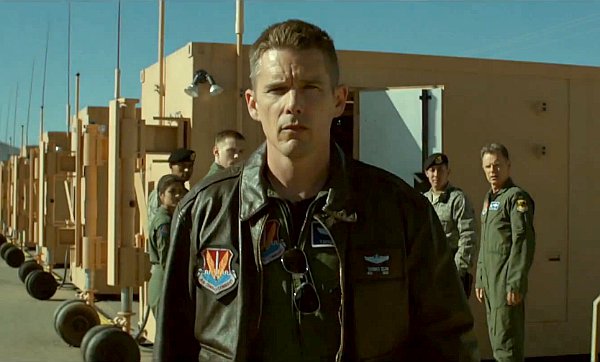
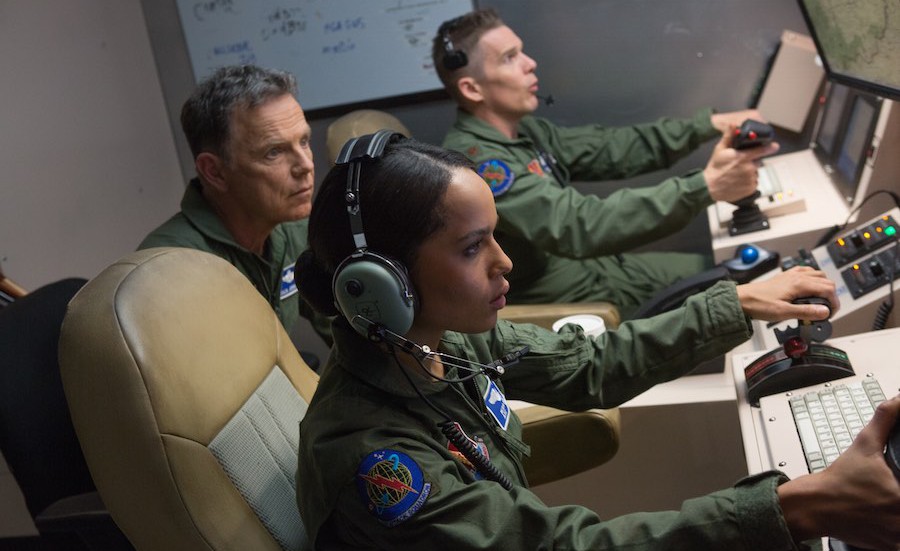
Good Kill opens very similarly to American Sniper – with a women and child caught in a cross hair, but where Chris Kyle found himself on the backline with a sniper, Major Tom Egan (Ethan Hawke) couldn’t be further away: piloting a drone in Afghanistan from an air-conditioned cubicle near his home in Las Vegas.For those unfamiliar with the workings of drones this world seems like science-fiction, but as the Colonel informs a bunch of new recruits – ‘This is not the future but the here and fucking now’. And this is set 5 years ago. Small teams of uniformed airman climb into freight containers and sit in front of a screen with two joy-pads launching attacks on Taliban 7000 miles away like some sinister back-alley arcade.
Egan scans for targets, locks and fires – counting down the moment of impact. The small figures on the monitor are engulfed by clouds of smoke. There is no audio, instead they flatly announce the hit – ‘Splash’… this does not sound like an explosion. Looking on through a screen they are far removed from the experience, us watching the film doubly so. If the low-stakes wager of killing people without ‘skin in the game’ is displacing for Egan, then we can’t help but find this micro-sized, muted attack uninteresting after a while. This is the point. We are becoming desensitised and uncaring – we are becoming in essence perfect recruits. Then all that’s left for the team to do is to tally the dead and deliver the empty, oxymoronic slogan – ‘Good Kill’.
There is something of writer director Andrew Nichols previous work here, not just Lord of War but elements of The Truman Show are in the strange contained suburbs of the soldiers families, and the ominous all seeing eye-in-the-sky. One of the more subtle anti-drone arguments made to highlight the likeness of American citizens and enemy forces is in the crooked God’s eye view that captures Egan at home, the wider shots showing mostly desert, reminding us of an image that we have seen many times already… just before the Splash.
Struggling to reconcile the morality of killing people without risk, ex-fighter pilot Egan and new recruit Suarez (Zoe Kravitz) are faced more directly with the dilemmas imposed by this new kind of warfare when they are selected to take direct orders from the CIA. As is clear from the title, this film is concerned with whether drone warfare is right – or justifiable. Where American Sniper was unflinchingly certain of its hero and the enemies he executed, Good Kill couldn’t be more opposed, focusing instead on the doubts and the casualties of war.
It sounds like a Daniel Tosh joke manifest: ‘We owe it to our troops to let them sleep in their own beds, wake up in the morning, have a delicious breakfast, and drive to war’. The reality is stark.
The arguments made throughout are all legitimate but so heavy-handed that they take you out of the film. It is impressive that such a stance has been taken, set during the escalated drone attacks in 2010 but nonetheless timely, a needed breath of fresh air from the flag-waving fair that we have become accustomed to. This is what makes Good Kill all the more frustrating.
For some characters it makes sense to be entering a debate but for others it feels like an obvious, sometimes laughable, device – the on-the-nose lines from Egan’s wife during an argument with her husband come on stronger than the Colonel’s recruitment speech. There is a time and a place and unfortunately the constant debate and half clever wordplay stands in for most of the dialogue and interferes with any real character development.
Though the drone angle is new and the anti-war stance is admirable, the film slips back into cliché melodrama when showing how Egan is torn apart by alcoholism and paranoia – this despite being able to drive home to a family bbq after a long day at war. Maybe this is the point but it becomes tired and predictable. It is a shame that more time wasn’t devoted to creating a character worth caring about so it could been a little cleverer with its message. Regardless this is a bold film that needed to be made.
Cobain: Montage of Heck is an evocative visual poem that paints the life and trials of the man at the helm of alt-punkrock band Nirvana.
With materials spanning Cobain’s childhood drawings, diaries, comics and countless pages of lyrics, the film takes on his voice, literally at times when the captured voice of a young Kurt narrates the stories on screen. Unlike Nick Broomfield’s documentary Kurt and Courtney which was notably affected by the material withheld by Courtney Love, Montage of Heck is built on a wealth of never before seen artefacts inherited and subsequently shared by their daughter Francis Bean.
Brought to life through different styles of animation and all set to Cobain’s music as somekind of violent musical, the film becomes a true reflection of his state of mind – each piece finding a place and allowing him to tell his own story. Alternate cuts of Nirvana tracks play as anthems under the teenage bouts of rebellion and depression from which they were born. Scrawled diary notes carry the angst and inner turmoil that would develop into his later more fully formed music, but also carry a poignancy in retrospect of his eventual suicide.
Meeting the various stages of Cobain’s torment – from his young, broken-home angst to his conflicted longing for a family and success – bursts of static and feedback blend nightmarish scenes filled with super 8 footage and animated sketches. But it seems that both successes as well as failures pose threats to Cobain, each in turn feels like a punch landed that could be the fatal blow.
Along with Nick Cave’s 20,000 Days on Earth, it seems the tired fly-on-the-wall has died and a more personal, complex form of music documentary has taken effect. A truly impressive film.
Set in Council Bluffs Iowa 1976, Behind Closed Doors looks at three young sisters and how together they overcome a harrowing situation and find solace in the most unlikely of places.
The opening music, paired with a glimpse inside the house where the girls live, is enough to tell us that the story being told has a dark underpinning. Written and directed by Lori Petty and based on events in her own life, the film carries a weighty seriousness that prevents the film from ever being enjoyable, but allows for some good performances.
Jennifer Lawrence is Agnes – the eldest daughter to a drug addicted prostitute, trying to take charge of the family and keep her sisters out of the ‘poker house’ where her mother’s clients and pimp freely roam.
Agnes is based on a 14 year old Petty, toughened beyond her young age, though unbelievable at times. Lawrence is commanding in her first leading role, which seems to have lead naturally to her matured, bread winning sister role in Winter’s Bone. The best moments of this film are caught in the tension between mother and daughter. Selma Blair is impressive as the girls’ mother – a twisted stumbling mess buried beneath platinum highlights and panda eyes.
Meanwhile sisters Cammie (Chloe Grace Moretz) and Bee (Sophia Bairley) both find themselves in amongst local characters in some hardly glamorous settings of their small town. Cammie exchanges recyclable bottles for sweets with the local homeless crowd, and Bee is put up in a bar for the day with an eccentric regular.
Despite the girls’ chin-up-and-smile attitude, theirs is clearly a tragic situation and all efforts to appear otherwise appear contrived or stooped in sentiment – which is understandable considering the personal nature of this film. The undeniable accomplishment of Behind Closed Doors is in showing the dark beginning from which film-maker Petty has arisen.
Opening to what is sure to be the trope of contemporary rom-coms, Two Night Stand begins with Megan (Analeigh Tipton) creating an online dating profile – filled with every hesitation, deliberation and embellishment.
Megan, the low-key manic pixie, has just broken off her engagement with her high-school sweetheart, and after graduating finds herself doing nothing – bumming around the apartment to the behest of her roommate. Following another tale of a twentysomething graduate starved of ambition and not knowing what to do with herself, just as Kiera Knightley’s Megan in the recent Say When (serious), this Megan isn’t so much looking for meaning in life as a one night stand to get back on the horse.
The eventual winner of this no-strings agreement is Alec (Miles Teller): a sardonic stoner who manages to offend his lucky catch as soon they wake in his Brooklyn apartment the morning after. But when she tries to make an exit and storm off, it appears that they have been snowed in by a freak blizzard and so must stay put and bask in the awkwardness of this forced situation.
Unfortunately so must we as the audience – with awkwardness that isn’t always intentional. Two Night Stand definitely reaches for comedy over creating chemistry between its characters, and so the intimate scenes feel out of place with a whiplash of tone change – especially when the cheesy clinking music cuts short and leaves you with enough silence to hear Alec breathing. There are some laughs throughout but the match of this big eyed, elfin, beauty with the dry and cooly distant Alec plays out just as you would expect… with utter convenience. There are some laughs throughout and it has a cutesy charm that keeps you entertained, but it is largely inoffensive and forgettable at that.
A couple of notes:
There was something quite jarring about this film that I couldn’t quite put my finger on at the time. It met it’s indie-film-quota before the titles and yet it looked all shiny and clean. It seemed that this polish revealed which parts were just cheap, tacky plastic…
The roommate and her boyfriend were cringe-worthy awkward with no charm or believability. They felt like glossy, unapologetic devices for the story. The sound design clashed with the images as sound levels veered wildly and the awful demo-music samples didn’t even last as long as the scenes. At one point Megan’s nose stud jumps nostrils while in a side profile close-up.. whilst her face fills most of the screen. These little mistakes were amplified by the look and feel of the thing.
Maybe Dan Harmon’s right when he says that romance is a condiment for a story, not the meal itself.


 samcooney