Reality is folded in on itself in this playfully mind-bending Filipino drama turned pulp action romp.
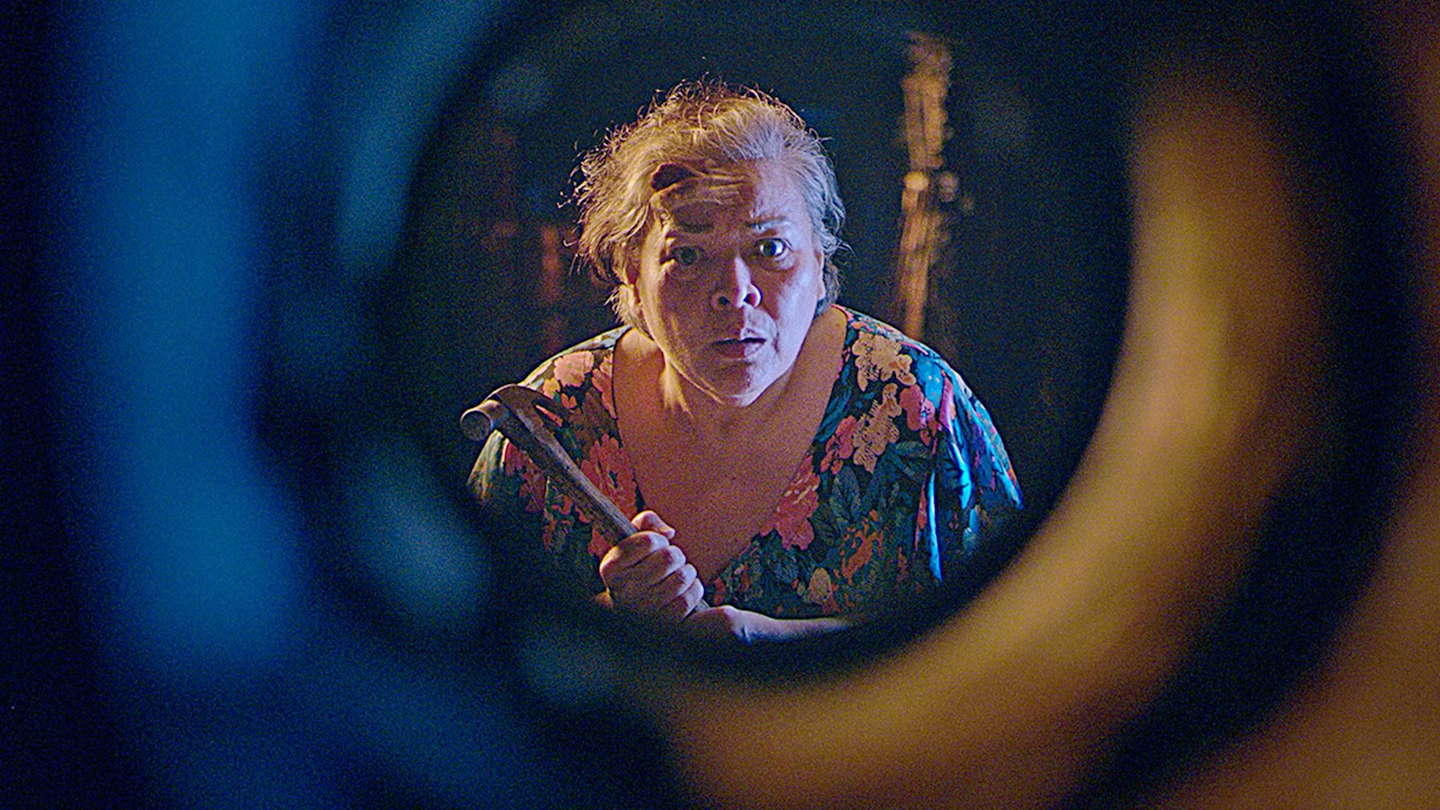
Leonor (Sheila Francisco), an ageing screenwriter with a taste for violent movies, is suddenly thrust into one of her own films when she is hit on the head by a television that puts her into a coma, leaving her in the thick of an unfinished vengeance story she had just dug up for a screenwriting competition.
Now a fly on the wall, she writes the story as she goes, observing action hero Ronwaldo (Rocky Salumbides) as he aims to avenge his brother (Raion Sandoval) and save the girl (Rea Molina) from a gang of drug-dealing street-toughs. Meanwhile, Leonor’s son Rudy (Bong Cabrera) with whom she is living back in the real world, tries to comfort his mother and pay the bills, by shopping around her unfinished script.
And so the film jumps from the domestic struggles of Leonor’s family to stunt-work and high body count shootouts. What makes the film within the film so watchable is the B-movie aesthetic straight out of 70s Filipino cinema: funky bass score, and sound effect heavy fight scenes that have instant replays.
Leonor Will Never Die is fun and inventive, able to dip into the action whenever it pleases. As novel as it sets out, it continues to get more complex as it progresses, adding layers and blurring lines of what is in the reality of the story – at one point Leonor’s family cannot find her in the hospital, only to find her in the action movie on the television.
Building to the classic genre showdown, it stays fun but gets a little greedy, piling on the self-awareness and deconstruction until it has nowhere else to go.
Revered photographer and artist Nan Goldin reflects on the events that shaped her craft and character, all the while fighting one of the most powerful families in America, in this challenging and poignant documentary.
Goldin is funny and unflinching, able to revisit trauma by tackling it head-on. Goldin delves into the loss of her sister at a young age, the ravaging effect of Aids on the queer subculture she was a part of in 70s New York, the political indifference that they faced as a result, and their reaction: to band together and speak truth to power.
The group that Goldin fell into in this social scene was comprised of artists, activists and outcasts. People who seemed to possess a knack for self-expression and a sense of humour. It was here that her artistic sensibilities were nurtured, turning the camera on a life largely unseen, laid bare and beautiful. We see part of the slideshows that she would show to crowds, the ever-changing series ‘The Ballad of Sexual Dependency’. In the documentary, we learn of her experiences with men and women, of domestic abuse, and sex work.
The scar that runs along the film however is Goldin’s own history with pain medication, namely OxyContin. Having battled addiction from this over-the-counter drug, and witnessed its destructive power, Goldin formed the group P.A.I.N. (Prescription Addiction Intervention Now) in 2017 with a group of likeminded people. Using her position in the art world to target the Sackler’s – the family and pharmaceutical empire often blamed for the opioid crisis in the United States – who have historically had their names in art galleries around the world. Here we see P.A.I.N as they infiltrate museums with elaborate signs and props, an artistic installation of sorts, that carries an important message, honouring the hundreds of thousands who have died in this epidemic.
Many of these reputable art houses would love to have the work of Goldin, but they get a little more than they bargained for.
The line between the convict on the stand and the witness in the box is blurred in this contemplative, courtroom drama.
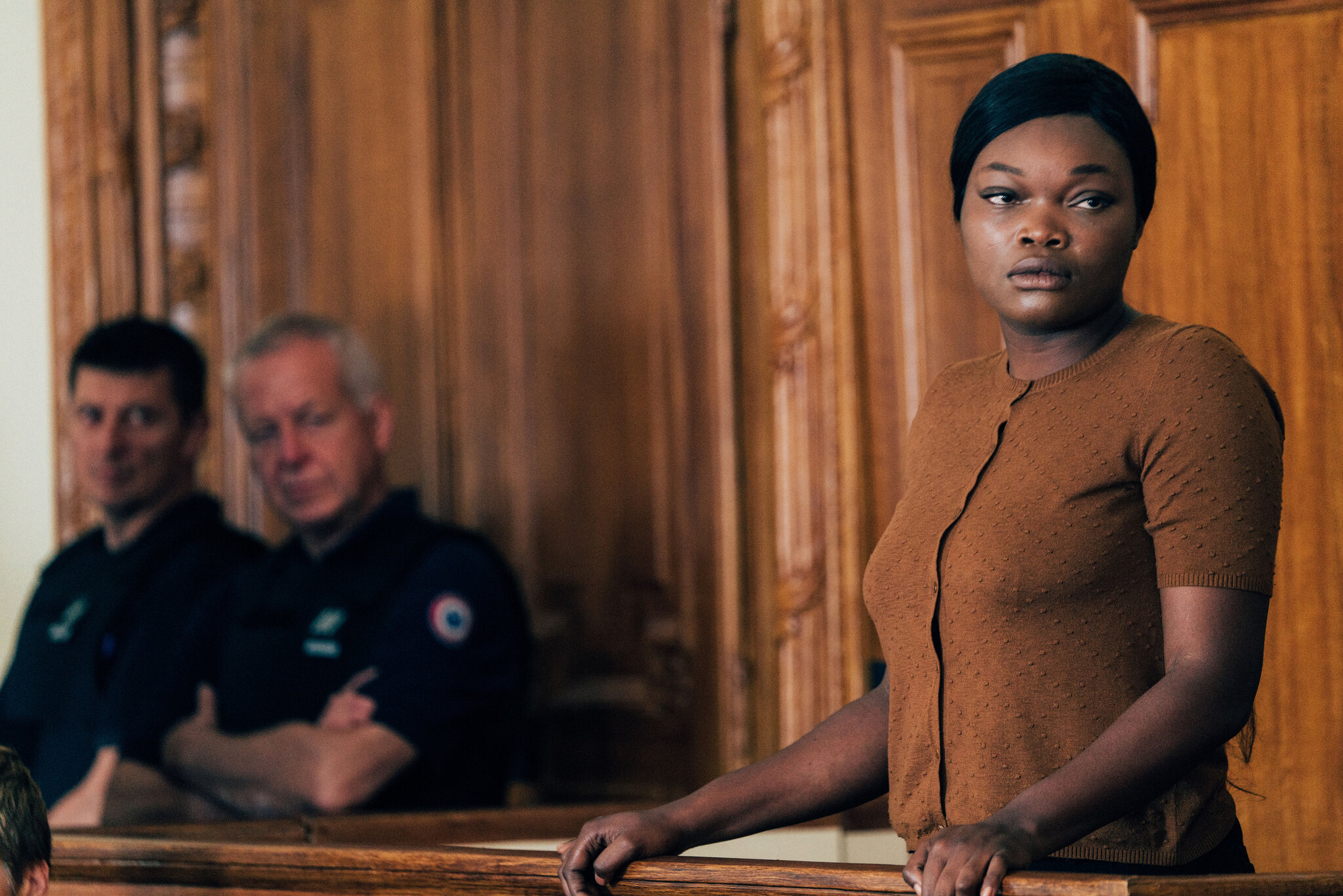
Rama (Kayije Kagame) a celebrated author, is in the process of writing a book when she is drawn in to the local trial of Laurence Coly (Guslagie Malanda): a women charged with the murder of her 15 month-old daughter. Like Cosy, Rama is French and of Senegalese decent, and seems ambivalent about her pregnancy.
Based on a real trial, that director Alice Diop attended, we see the complexity of characters presented through their testimonies, but also in reaction to the testimonies of others. The film is very deliberate in its voyeurism. Long takes focussed on a single person allow you as the audience to become the jury. Avoiding theatricality, it is the nuance, the micro-actions and reactions, that make this film resonate so deeply.
Cosy (played phenomenally by Malanda), is introduced as someone who has committed the most heinous crime of infanticide. Having left her child on a beach as the tide was coming in, she confesses that she is responsible, and yet bafflingly pleads ‘not guilty’. This is just the beginning of this difficult and contradictory series of revelations. As we listen to Cosy speak in defence of herself, she is eloquent, a gifted student of philosophy she has a way with language, and so is able to express a certain messiness that is ultimately human.
This spell is sometimes broken by the pointed questions of attorneys, like for instance after the testimony of the murdered child’s father (Xavier Maly), a more senior man whose sincerity is deconstructed swiftly by some perfectly aimed accusations.
As well as unpicking these personalities, the film throws into question larger ideas and assumptions. The whole legal system is seen as a product of its culture when the defendant claims that ‘sorcery’ was involved, creating a debate around the validity of African mysticism in a Western court of law.
Saint Omer is slow paced and purposeful; it does not pander but simply gives you room to observe. It is simple and confident filmmaking that will appeal to active watchers who like have their views challenged.
Three lives are entwined in Brighton in the 1950s, a love triangle forming against a backdrop of criminalised homosexuality.
My Policeman jumps between the meeting of a young couple and their lives together decades later, retired in a coastal humdrum town. This is disturbed however by the presence of an old friend, now disabled and in need of care, unravelling dark secrets from their past.
Tom (Harry Styles) is the titular copper, unusually innocent and curious as noted by museum curator and amateur artist Patrick (David Dawson) who offers to draw his portrait after a chance meeting, marking the beginnings of a peculiar friendship. It is not long after this that Tom meets Marion (Emma Corrin) a plain but excitable teacher who is smitten but fears that the feeling isn’t reciprocated. This is part of the story mind, and not simply because of Styles’ acting which kills all chemistry that could have been.
In the present, Tom and Marion (now played by Linus Roache and Gina McKee) are in a loveless marriage that has become a stilted and depressing affair, highlighted by the arrival of old friend Patrick (Rupert Everett). As dull as it is bleak, these performances sadly don’t draw anymore interest than the cast of characters in the past.
The subdued love story is rather ordinary until some information is uncovered that sheds new light on this group, explaining why their lives are so fraught and joyless now. However, this isn’t enough to make the story interesting or the characters sympathetic.
As the excitement fades for the new lovers, it does for the film also, as we trudge through the sad reality of unexciting compromise and emptiness.
On the Edinburgh to Kings Cross I avidly read through Book 2 of Dune.
I follow Paul as he is tested by the Fremen, the mysterious tribe of the desert. He is challenged to a fight to the death, and despite having a vision of himself dying, is victorious – fulfilling yet another of the religious prophecies that foretell him as their saviour. Paul and his mother Lady Jessica are then taken to their new sietch – the underground collective of Fremen to whom they have banded.
Now, we have only heard about the sietches on the planet, and heard rumours about how many Fremen there actually are and so as I change trains, and a bunch of several dickhead children and parents alike hop on board, I scramble for my headphones and my iPod nano, because apparently I too have ancient customs, in the hopes that I have some appropriate music. Evidently I’d cleared off my frightfully perfect Clint Mansell scores and the only relatively instrumental music I find is Four Tet’s Randoms from 2016 – a compilation of odd tracks.
It begins electronic, clanky and thumping, giving enough noise to cancel out the tinny phone videos that are playing throughout the carriage. Good stuff.
The sietch! There are many thousands of people. At the heart of this meeting, Lady Jessica is partaking in a ceremony, the details of which remain unknown to her, and us. Only that it involves meeting the Fremen Reverend Mother, a wise and wispy mystic. We are told she hasn’t long to live. Lady Jessica is then presented a sackful of water and told to drink, she is hesitant but can’t stop it from happening. We are in Lady Jessica’s thoughts as time slows down.
At this point the track For These Times comes on in my ears. It is up tempo and industrial, not necessarily something I’d have chosen for this scene. But then the vocals fade in, simply repeating the word ‘Time’. Lady Jessica perceives that the water is drugged and is poisonous, but she feels the effect of the drug allowing her to perceive time much slower and is able to force her body to react to the water she is ingesting. The beat drops, the vocals persist: time, time, time. This is perfect, I am wearing a shit-eating grin and feel a contact high, a rush of psychedelic symbiosis.
Lady Jessica is not only protecting herself from the water, but taking in this psychoactive drug and experiencing many sensations. As the Reverend Mother touches her, they speak almost psychically, and begin to merge – Lady Jessica takes in all of this woman’s life experiences, and the Reverend Mother’s that proceeded her. These are ancient people, that have lived long before the Bene Gesserit, her own bloodline of witches.
Next song is Pockets, opening with an alien whining, a tractor beam that comes in waves, fading to digital twinkling notes and a repetitive beat that take me deeper in. Lady Jessica is not only protecting herself from the water, but making it safe for others to consume; through this ritual she is becoming Reverend Mother, but something is wrong. She is pregnant, and this stream of information is passing through her and her unborn daughter without protection. Those alien waves again. This unfiltered surge of information threatens to make Jessica’s unborn daughter insane and so she must do whatever she can to protect her – finding the best way is to send her thoughts and feelings of pure love.
The music stops suddenly and there is the sound of one voice. A young girl sings a phrase that repeats. Gradually other voices speak in the breaks as a subtle synthetic wave washes underneath. It sounds like call and response. A young girl repeats the words ‘I love you’.
Lady Jessica offers the water out to everyone so that they may share in its effect now that it is safe. Paul retreats with a young Fremen girl that he recognises from a dream. She shares in his visions as they make love.
Book 2 ends and I am left electrically charged. I look at the iPod to the name of the track: Gillie Amma I Love you. We arrive at the station and I practically float home. Once in, with all of our luggage, I rush to look up the song. It is in Tamil, and performed by the Light of Love Children’s Choir from Southeast India. And only just now as I write this did I Google translate the lyrics from Tamil:
Oh mother…mother…mother you are
You are the embodiment of love
Belong to the world like you
No one
Some people think God talks to them through the synchronicity of Pink Floyd’s Dark Side of the Moon and The Wizard of Oz.



 samcooney