Supercuts

While some actors are typecast or have roles written for them based on something they do well – like Sam Rockwell dancing, Al Pacino shouting or McConaughey getting his tits out – some actors have traits or quirks that seem to resurface time and again through different characters, blurring the line between the the actors themselves and the people they are pretending to be.

This becomes a strange paradox when escaping into the world of a film, like a little fourth-wall-breaking nod that clues you in, a Wilhelm scream to those in the know, but ultimately a hurdle to escapism. You are already having to forget that you are watching an actor pretend to be a character, but how can you while they remind you of the fact.

Eating is a strange one. The character is hungry, the actor is not. Or maybe they were before the first take. It’s kind of unnatural and yet it is an automatic function.

In his debut Primer, the unsettlingly brilliant Shane Carruth who wrote, directed, produced, edited, scored and starred in the film, also cast his friends. In directing non-actors he found that having them eat something during the scene prevented stilted, awkward takes. It taps into the automatic function and makes it more realistic, more human.

It’s interesting still to see characters that are defined by the manner in which the eat – take for instance Adele from Blue Is The Warmest Colour who eats like a fucking slob, but she is sexy, carefree and French so it makes her louche.

Some of these compilations are surely just based on coincidence considering the sheer amount of films they have acted in. But in other cases it’s just too perfect. Does Denzel improvise with his dialogue – bringing out the same confidence-inspiring turn of phrase in whichever film he happens to be starring in?

These reoccurring traits surely impinge on your idea of the character – and show that it’s not so simple to separate them from the actors portraying them. It’s for this reason that I find it easier to believe actors that I’ve never seen before, easier to suspend disbelief when you know less of their work or less about their own lives. I think ideally actors should work once and then be forced to live in obscurity on an island somewhere…

But then again some actors bring with them the weight of their public persona (Tom Crusie’s Frank TJ Mackey) or their previous performances, building off of them, or playing off of them.

Then there’s William H Macy.

What the fuck do I know.
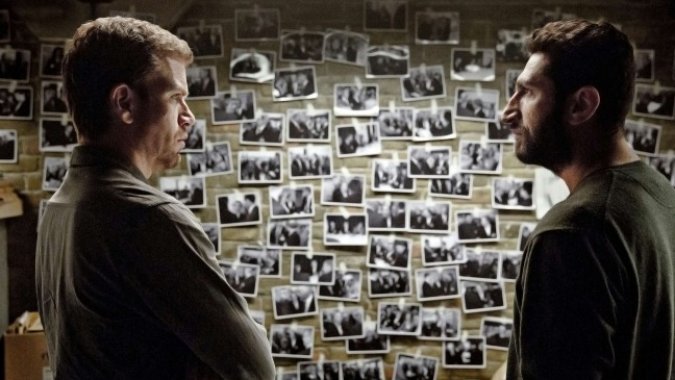
The Absent One (2016)

Written for RAF News April 2016

A young woman who has been missing for years may be the only key to solving a case that has long been buried. The Absent One is the second in a series of crime novel adaptations, and another in a long line of brutally uncompromising thrillers, to be exported from Denmark featuring rape, revenge and corruption at the core.

keeper_of_lost_causes_-_h_-_2013

The double homicide of twin siblings in 1994 resurfaces due to the victims’ father killing himself 20 years later. This is not long after he had warned the new police inspector of Department Q that all is not as it seems. With this death weighing down on his conscience the ever-serious Carl Mørck (Nikolaj Lie Kaas) reopens the investigation despite already being swamped in unsolved murders, and despite the fact that someone had already confessed and served time for the murder in question.

The cold cases team consists of Syria born Assad, red-haired Rose – who is more of a silent guiding force than a secretary – and headed by the permanently furrowed brow of Carl Mørck, whose strong features and stoic attitude strangely enough reminds of Arnold Schwarzenegger. It is late into the film before we are offered any insight into the character of Mørck, but it is done with great finesse and performed perfectly by Kaas, as we discover his drive to help those who need him.

The teams only lead is a call made by a young and petrified Kimmie Larson (Sarah-Sofie Boussnina) back in 1994, informing them of the murder in darkly cryptic poetry – they must find her and learn all that they can about this dark history, and about the company that she kept at her elite boarding school.

The Absent One is a detective story but told from all perspectives, jumping between the past and the present, which leaves the film intentionally disjointed.With its scarcely lit noir style the story feels familiar and yet these Nordic thrillers still find ways of pushing the envelope and creating uncomfortably dark scenes. These flourishes and the honed, sleek style don’t so much reinvent the genre but they keep it interesting.

Despite the Falling Snow (2016)

Written for RAF News April 2016

Taking place during the height of the Cold War, Despite the Falling Snow follows the relationship between rising Soviet politician Alexander Ivanov (Sam Reid) and the new love of his life Katya (Rebecca Ferguson), an entrancingly seductive Russian spy who gets a little closer than she intends to, falling for her target and jeopardising her mission.

This story is intercut with Alexander decades later in New York, now played with authoritative command in Charles Dance, as his niece Lauren (also played by Rebecca Ferguson) plans a trip to Moscow to exhibit some of her political artwork including a portrait of the woman who shares her likeness. Here she will end up uncovering some of her uncle’s past, finding herself tangled up in the same web of lies and deception, before finding the truth of what happened to Katya back in 1959.

Adapting her best-selling novel for the screen and directing herself, Shamim Sarif brings sensitivity and tenderness to the relationship of Alexander and Katya. Particularly in the character of Alexander, played by Sam Reid as broad-shouldered and square jawed but gentle and naive. At first it seems like this doesn’t match the character at all, at least not how Charles Dance plays him later in life, but it becomes clear that this softness of touch is defining of Alexander’s sensibility and ultimately his undoing.

Perhaps down to the adaptation the dialogue is often clunky and unnatural, and though it can a sometimes feel like a television drama the story of these two lovers tied to opposing forces is compelling, with twists and turns in both timelines. The performances are befitting of their characters, especially a vodka-soaked cameo from Anthony Head which shouldn’t be missed.

Disorder/Maryland (2016)

Written for RAF News March 2016

Back from service in Afghanistan as part of the French Special Service, Vincent (Matthias Schoenaerts) shows signs of post-traumatic stress and so finds some private security work before he can return – if he can return. His judgement seems to be clouded though by his apparent disorder as he struggles to tell apart real threats from paranoid delusions.

screen-shot-2016-02-09-at-20-26-18-e1455049833503
“A lot like Nicholas Winding Refn’s Drive but takes itself very seriously.”

Vincent is a brooding figure who shows little more than his vigilant drive to protect. The first half of the film is an interesting and stylised exploration of his state of mind in which we experience a job from his perspective. Hired initially as security for a wealthy Lebanese businessman who is hosting a party, we observe potential threats whilst the overpowering bass of dance music drowns out all voices and throws your focus.

The use of penetrating sound and the uncomfortably closed in shots of Vincent’s face as he stalks guests through the crowd works well to overwhelm your senses and create palpable tension. This discomforting paranoia will plague the entire film and create some extremely suspenseful scenes.

Schoenaerts is great without even having to speak. He acts with his body, showing a raw animalistic quality that has him physically restrained until he can find an outlet. He is threatening, even to the family he is hired to ‘babysit’ when the businessman leaves town. It is only when Vincent is left alone, protecting the client’s wife (Diane Kruger) and son that the threats seem to become more real, but how certain can he be?

At first it feels as though Disorder will be a thoughtful but very different take on PTSD. But this message is abandoned half way into the film as it quickly becomes more of a genre film, an action thriller. It remains stylised and tries to hold on to the drama but it becomes almost a horror film by the end. As a result the message of Disorder is lost, albeit to very tense and involving action.

disordersodadistributor

This sudden plummet into a different genre changes the way in which you view Vincent and ultimately it creates a very unclear message. In ghost films there is often a character who warns everyone else, who senses a presence and is usually laughed at until the doubters are mutilated by said presence. The film aligns with this position because the idea of there not actually being a threat is less interesting for this kind of film. In Disorder, Vincent senses ‘the presence’ but it is clearly fallout from his PTSD, until it isn’t. Until the point where his paranoia comes true. I am not sure what is to be inferred by this? Is his disorder practical? Does he even have a disorder or is he just some clairvoyant Jason Bourne? It seemed like a cheap way to cash in on the tension created up until the last act. A cop out from creating non-action drama.

Even still the film was different enough to be compelling. The style was interesting even if there weren’t many realised characters or much of a story. It felt a lot like Nicolas Winding Refn’s Drive – a taciturn father surrogate brutally kills bad guys with supposed moral justification, shown with European flare through the striking visuals and an important score -but Disorder seems to take itself more seriously, pretending to be something more, something deeper… for an hour at least.

Create a free website or blog at WordPress.com.

Up ↑