A Girl Walks Home Alone at Night (2015)

Bad City, a comic book mesh of Iran and the US – like the film’s writer/director Ana Lily Amirpour – where pimps, whores and drug addicts fill the street at night, watched over by a lone girl in the shadows: a vampire in a veil.

girl

The genre is given new cultural significance in this middle-eastern setting despite being shot in the Californian desert. The chador becomes a cape. The meek silence of an impassive woman becomes more an ominous threat. The Girl isn’t lead around by men, she stalks them.

The vampire becomes an icon of female empowerment and violent revenge as the seemingly vulnerable girl walking home alone at night is actually the predator here. Yet still, after punishing a lowlife pimp who closely resembles Ninja from Die Antwoord, this moral avenger knows she has done wrong. She is bad. Sinful even.

Shot in black and white, spoken in Farsi, and with a sleek soundtrack comprised of indie, punk, traditional Iranian music and tinges of Ennio Morricone, the film is aware of how cool it is, or at least how cool it wants to be – take for instance our vampire’s penchant for skateboarding, or our James Dean modelled hero Arash.

The confidence of the film, reinforced by often beautiful composition, does allow certain scenes to unfold slowly and with greater impact. One truly beautiful scene sees Arash in The Girl’s room, dressed up as Dracula, very gradually approaching her back. A spinning disco-ball throws fractured light around the room, adorned with slightly off iconic music posters (think: Ghana’s bootleg movie posters), as the distance between them is closed so very slowly, lasting almost an entire song.

Unfortunately these slower, more deliberate scenes are dropped in favour of typical genre conventions, steering into something much more predictable with less flair and originality. There isn’t much to the story itself, and some crucial moments and character decision’s really don’t add up.

Overall the film does feel a little style over substance, but it sure is a sleek style worth paying attention to. At times.

Moomins on the Riviera (2015)

Written for RAF News May 2015

Tove Jansson’s classic comic strip has found its way to the big screen after 60 years, with the Moomins setting sail for the south of France in search of adventure and a taste of the high-life.

MoominsOnTheRiviera

Snorkmaiden, taken by the allure of champagne on the beach, leads Moomin (a cingeworthy Russel Tovey), and his family, as they set out in a humble sail boat across stormy seas to find themselves like fish out of water among the glitz and glamour of the Riviera.

The traditional hand-drawn animation gives the film a beautiful composition that can at times blossom into glorious surrealism – roughly sketched storm clouds shed long streams of raindrops over a golden sea as the well-meaning Moomins find themselves in trouble once again.

Where most films aimed at children these days have an edge to them, layered with jokes for the parents or breaking from the story with a wink-nudge, Moomins on the Riviera carries charm in its sincerity (although there is one brilliantly absurd moment when a character falls in love and has to get his cousin to take his place in the story whilst he gets married.) Where 2D cartoons like SpongeBob SquarePants and puppets like the Thunderbirds have been converted into CGI its impressive how Moomins holds onto its very essence in both values and visual style.

Throughout their ordeal of being mistaken for eccentric royalty and running up bills that they can’t pay, the Moomin family maintain their naïve sense of wonder and innocence. Though they can be swallowed by insecurities and anxiety, they are for the most part delightfully free of self-awareness. This works in complete contrast to the snooty jet-sets of the south of France where the sharp faced locals are interested only in status and celebrity. “We simply don’t fit in here” comments MoominMama, noticing the gap between their way of life and that of local star Audrey Glamor.

Moomins on the Riviera meanders for the most part but it is certainly a heart-felt children’s film that, like the family leading the adventure, isn’t trying to be something it isn’t and embraces its character.

Spooks: The Greater Good (2015)

I hadn’t seen a single episode of popular English spy-drama Spooks before watching the new film – and it looks like it’ll stay that way. It had been described to me as less clean-cut and more toned down than its American counterparts but had started to grow more farfetched over its seven series stretch.

spooks

Spooks: The Greater Good opens to a London skyline behind a curtain of rain and queues of traffic stretching to the horizon – this seems realistic enough – but not the most desirable situation for the MI5 agents at the centre of this hold-up, guarding Adem Qasim (Elyes Gabel) a terrorist in transit. Something is wrong. Soon Qasim will make his escape and heads will roll.

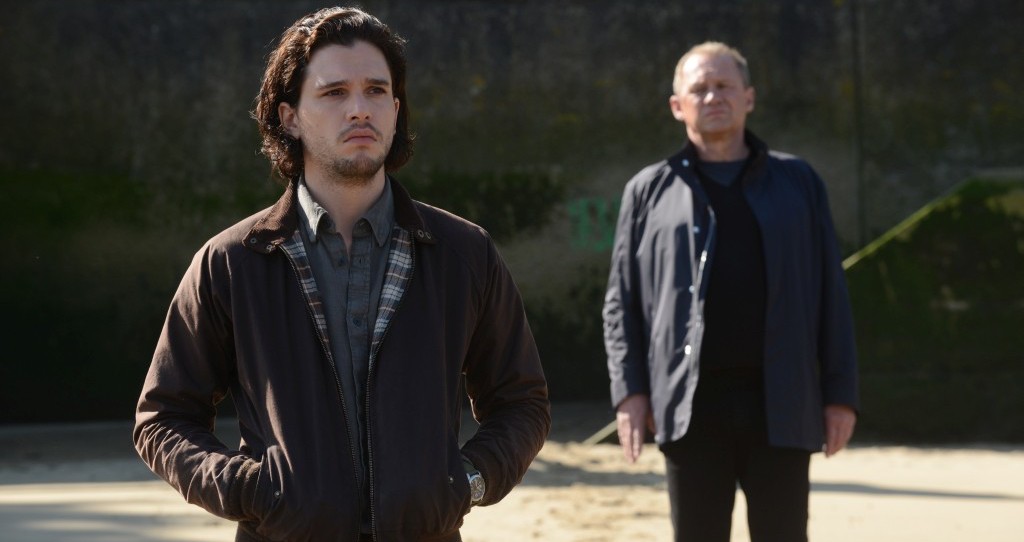
Held responsible for this debacle, Spooks stalwart and Head of Counter Terrorism Harry Pearce (Peter Firth) is forced to resign and disappears soon after. With the organisation now under threat – they look to a fresh face to find Harry and the truth behind his disappearance.

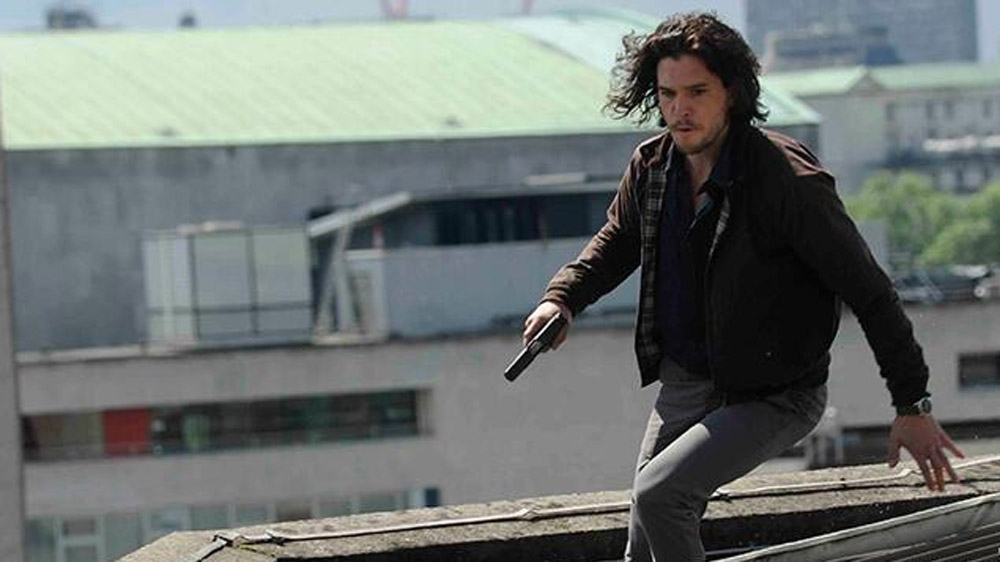
Kit Harrington has traded Longclaw sword for government issued pistol as Holloway – the sharp, fast-thinking ex-MI5 agent who believes Harry is still alive. Speaking mostly in a gruff whisper, in need of a Strepsil, he’s most impressive when in action, and luckily for us he rarely stops for breath.

Spooks: The Greater Good certainly has its impressive set-pieces including Qasim’s breakout and a final shootout, both making the most of their locations. But in-between these bookended sequences there is barely anything other than hammy exposition-laden dialogue: suspicions running high, and characters just running. In these instances the locations become a distracting backdrop. When the film isn’t darting to Berlin and Moscow with sweeping aerials, it’s hopping about through postcard London skylines.

Spooks

Amidst all the toing and froing there’s everything you’d expect from a twisting espionage, filled with double crosses and conversations at the barrel of a gun. Surprisingly though, most of the film revolves around paranoia among the bods back home at ‘The Grid’ and as such the action scenes give way to TV melodrama. Qasim seems a more complex and rational villain, but he is talked about more than he is seen.

When the action sequences are in full swing the film is gripping but caught up in whom to trust, the film loses sight of the threat and the tension suffers for it.

Queen and Country (2015)

Written for RAF News Apr 2015

Queen and Country is John Boorman’s follow up to his Oscar nominated classic Hope and Glory – where the first film told a semi-autobiographic tale of his childhood during WW2 through the character Bill Rohan, this sentimental sequel picks up in his late teens when called for National Service in the Korean war.

q+c

Luckily for Boorman, and his film equivalent played by Callum Turner, his duties consist of teaching recruits to type before they are shipped out to the frontline. The biggest threat to Bill is his pedantic Sgt. Major Bradley (David Thewlis) who has the manual of military offences committed to memory. Bill catches some of his righteous fury when accused of seducing a soldier from the course of his duty after speaking out against the war, and so too does his close pal Percy after meddling with the RSM’s precious clock.

By focussing on the pair’s frivolousness antics against the backdrop of a hellish war, Boorman once again explores his own personal, perhaps wilfully naïve, experience – continuing on from Hope and Glory with the same light-hearted whimsy. The film is certainly a comedy with a traditional more campy approach but this later effort edges closer to romance. Where he once sought companionship from local kids rummaging around bomb sites for trophies of shrapnel, Bill now longs for a girl known only to him as Ophelia.

Turner is pleasantly understated as Bill, though this may just be in contrast to Caleb Landry Jones who gives a strange and strained performance as his sidekick, pursing his lips and chewing scenery when given half the chance. Aside from this pair, it is the supporting cast who steal the film – Pat Shortt’s professional skiver and David Thewlis’ uptight Sgt Major carry the laughs, whilst Vanessa Kirby adds a dose of dynamism as Bill’s sister back home.

Good Kill (2015)

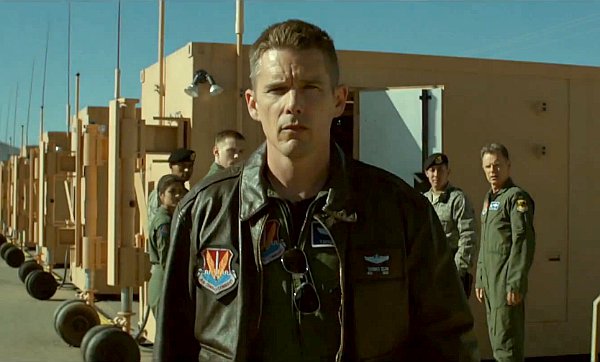
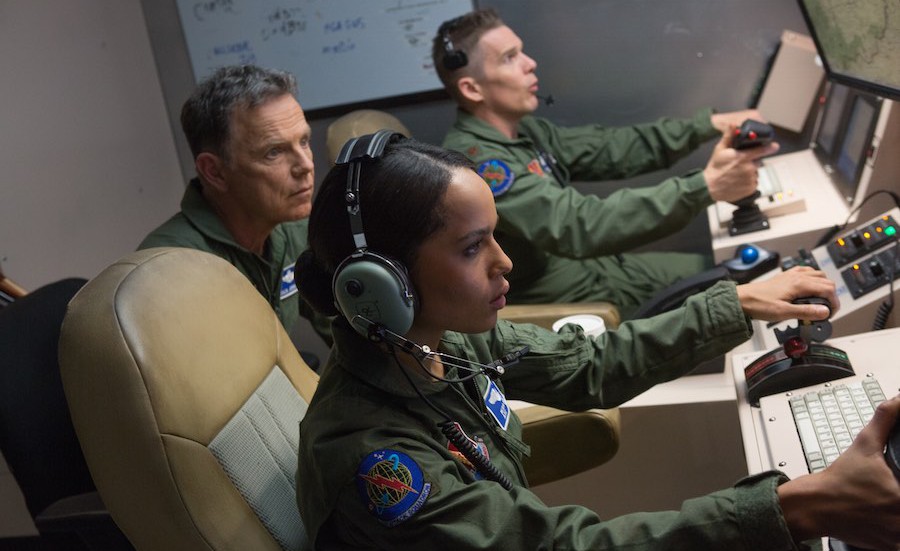
Good Kill opens very similarly to American Sniper – with a women and child caught in a cross hair, but where Chris Kyle found himself on the backline with a sniper, Major Tom Egan (Ethan Hawke) couldn’t be further away: piloting a drone in Afghanistan from an air-conditioned cubicle near his home in Las Vegas.good-killFor those unfamiliar with the workings of drones this world seems like science-fiction, but as the Colonel informs a bunch of new recruits – ‘This is not the future but the here and fucking now’. And this is set 5 years ago. Small teams of uniformed airman climb into freight containers and sit in front of a screen with two joy-pads launching attacks on Taliban 7000 miles away like some sinister back-alley arcade.

Egan scans for targets, locks and fires – counting down the moment of impact. The small figures on the monitor are engulfed by clouds of smoke. There is no audio, instead they flatly announce the hit – ‘Splash’… this does not sound like an explosion. Looking on through a screen they are far removed from the experience, us watching the film doubly so. If the low-stakes wager of killing people without ‘skin in the game’ is displacing for Egan, then we can’t help but find this micro-sized, muted attack uninteresting after a while. This is the point. We are becoming desensitised and uncaring – we are becoming in essence perfect recruits. Then all that’s left for the team to do is to tally the dead and deliver the empty, oxymoronic slogan – ‘Good Kill’.

There is something of writer director Andrew Nichols previous work here, not just Lord of War but elements of The Truman Show are in the strange contained suburbs of the soldiers families, and the ominous all seeing eye-in-the-sky. One of the more subtle anti-drone arguments made to highlight the likeness of American citizens and enemy forces is in the crooked God’s eye view that captures Egan at home, the wider shots showing mostly desert, reminding us of an image that we have seen many times already… just before the Splash.

Struggling to reconcile the morality of killing people without risk, ex-fighter pilot Egan and new recruit Suarez (Zoe Kravitz) are faced more directly with the dilemmas imposed by this new kind of warfare when they are selected to take direct orders from the CIA. As is clear from the title, this film is concerned with whether drone warfare is right – or justifiable. Where American Sniper was unflinchingly certain of its hero and the enemies he executed, Good Kill couldn’t be more opposed, focusing instead on the doubts and the casualties of war.

8E9A6700.CR2
It sounds like a Daniel Tosh joke manifest: ‘We owe it to our troops to let them sleep in their own beds, wake up in the morning, have a delicious breakfast, and drive to war’. The reality is stark.

The arguments made throughout are all legitimate but so heavy-handed that they take you out of the film. It is impressive that such a stance has been taken, set during the escalated drone attacks in 2010 but nonetheless timely, a needed breath of fresh air from the flag-waving fair that we have become accustomed to. This is what makes Good Kill all the more frustrating.

For some characters it makes sense to be entering a debate but for others it feels like an obvious, sometimes laughable, device – the on-the-nose lines from Egan’s wife during an argument with her husband come on stronger than the Colonel’s recruitment speech. There is a time and a place and unfortunately the constant debate and half clever wordplay stands in for most of the dialogue and interferes with any real character development.

Though the drone angle is new and the anti-war stance is admirable, the film slips back into cliché melodrama when showing how Egan is torn apart by alcoholism and paranoia – this despite being able to drive home to a family bbq after a long day at war. Maybe this is the point but it becomes tired and predictable. It is a shame that more time wasn’t devoted to creating a character worth caring about so it could been a little cleverer with its message. Regardless this is a bold film that needed to be made.

Create a free website or blog at WordPress.com.

Up ↑