High Life (2019)

Written for RAF News May 2019

A lone prisoner aboard a spaceship takes care of a baby girl as his ship sets course for a black hole in this beautifully bleak but challenging film.
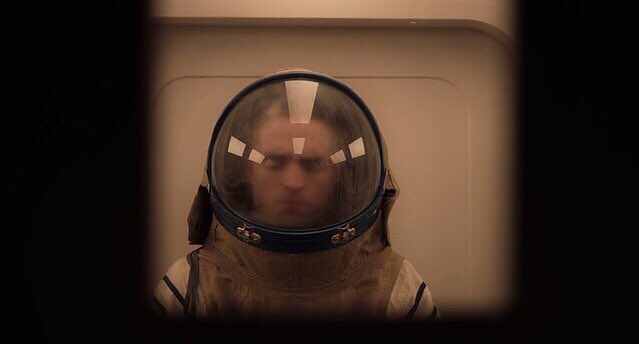
Image result for high life stills

Director Claire Denis has stressed that this is not science-fiction despite the setting. This is true in as much as it is focussed on the human story over special effects, but it is far from ordinary.

The opening features Monte (a tenderly detached Robert Pattinson) carrying out work on a rundown ship and tending to baby Willow (Scarlett Lindsey), sometimes at the same time. In this large vessel that has the isolation of Silent Running and the dirty futurism of Alien: they are alone. Single-fatherhood distilled to the elation of witnessing first steps to pleading for quiet in order to keep sane.

The initial meandering pace of High Life sets expectations for a slow meditation on the human condition, when in fact it will explore this territory but by means of a darkly tense prison drama that tips occasionally into horror and eroticism. Cutting back in time we learn about the purpose of this ship and what happened to the crew before catching up with Monte and Willow much later.

This was a penal colony for death-row inmates who had volunteered for a suicide mission to harness the power of black-holes for Earth. Along the way however they get tangled into twisted experiments of reproduction. This additional research is all under the command and control of Dr. Dibs (Juliette Binoche) who brags of being the only criminal onboard worthy of the name. Combining scientific garb with a waist-long braid she is positively witchy, keeping the others sedated and giving them drugs in exchange for their participation.

A noteworthy scene sees Dr. Dibs strapping herself into the ‘fuckbox’, an isolated cubicle that appears to simulate and stimulate simultaneously, bringing out erotic visions and sensations. Shown within a vacuum, this bizarre sensuous experience is powerful and enveloping.

The film seldom leaves the confines of the ship, and when it does it’s to mysteriously vague memories washed out with 16mm grain, creating more questions than answers, which can frustrate or delight.

Awash with mystery and symbolism High Life climbs inside your head and challenges you to make sense of it, and I accept the challenge gladly.


Donbass (2019)

Written for RAF News May 2019

A series of short vignettes link together this satirical social commentary set in present day eastern Ukraine, depicting the chaos caused by propaganda and corruption.

Image result for donbass film

The Donbass region is shown pulled apart by civil war, Russian- backed separatists occupy territories with armed soldiers patrolling every street in the name of fighting fascism – though the term ‘facist’ is banded about quite freely and the sides aren’t too clear.

There is a farcical quality that feels nonetheless genuine in Sergei Loznitsa’s film, which makes it all the more frightening. It seems there is common understanding among the people to take any official announcement with a heap of salt. They have a prescribed scepticism that reads as hopeless confusion: no-one believes what they are told but they daren’t speak out.

The film opens in a make-up trailer full of actors being prepped to play innocent bystanders in what turns out to be a staged attack for a news crew. Instructed by belligerent producers with the heft of soldiers, it is revealed that these extras haven’t even been paid, they are practically prisoners of the state. And yet this is all delivered with a sly sense of humour.

There is a visit from a black leather jacketed official to a maternity clinic, reassuring the staff that there are in fact medical supplies, they’re just in the doctors office, in a fridge packed with sausages, beside many other such rations. The doctor must have taken them to sell on the side. This may be true but later he is seen rubbing shoulders with the official himself.

Other segments consist of politicians squabbling over bribes, journalists struggling to get answers from anyone, a tour of a bomb-shelter in the heart of the war-zone to a bizarre wedding ceremony that has the feel of a football game. The tone veers from darkly funny to plainly dark, especially in one brutal extended scene that shows a supposed defector tied to a post in order to receive beatings from the public.

With it’s contrasting chapters and intermittent humour, Donbass is fittingly confusing. There are shocking moments sprinkled among the more amusing absurdity, which might overwhelm or distance the viewer, but the message is unmistakeable.

Vox Lux (2019)

Written for RAF News May 2019

Vox Lux boasts of being a ’21st Century portrait’, the subjective of which is a young girl who rises out of horrifying circumstances to become a pop superstar.

Image result for vox lux

Divided into two distinct halves the film opens to 14 year old Celeste (Raffey Cassidy) returning from school break where she experiences an act of extreme violence. In the wake of tragedy, she performs an original song at a candlelight vigil that captures the pain experienced by her peers and connects with the public. The second half jumps ahead by 18 years to see Celeste (Natalie Portman) as she prepares for a concert in a packed arena.

Vox Lux is a success story on the surface but the distinct contrast in Celeste’s personality from adolescence to adulthood appear to condemn the very nature of success, more specifically its parasitic off-shoot: Fame.

Celeste receives our complete empathy in the beginning and when her talent is recognised there appears to be some karmic reciprocity at play. Wide-eyed and excitable she enters this world of studio recordings and music videos, but forward in time, becoming a global sensation and a single mother, she appears complacent and entitled, her narcissism fostered by her family, management and fans.

The two constants in both parts of the film are Celeste’s manager, played with a nice comedic touch from Jude Law, and her sidelined sister Eleanor, an increasingly empty Stacey Martin, who becomes mother surrogate to Celeste’s daughter and the silent partner who writes all of her hits.

The shocking imagery that is used to open Vox Lux, recurs once more in another act of extreme violence, and yet it doesn’t seem to go anywhere. The message might be that fame and infamy aren’t far apart, that the media is a monster-making machine, or it may be a comment on gun control.

Vox Lux is never boring but you want it to go further. It doesn’t give you many answers, which is great, but it doesn’t leave you with many questions either. The sparsely used narration by Willem Defoe seems to be an after thought intended to add weight. It struggles in the end to transcend the hollowness of the tacky aesthetic that it lavishes in throughout the final chapter.

Create a free website or blog at WordPress.com.

Up ↑